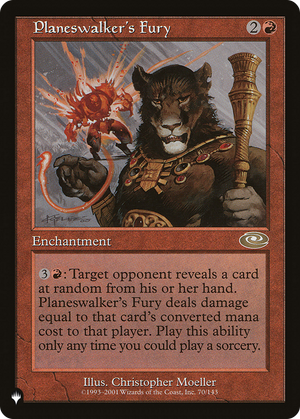
Planeswalker's Fury


Here is a damage spell that hands the dial to your opponent's draw step rather than your own deckbuilding. Pay four mana, and a random card from their hand decides how much it hurts: a flooded hand of basics deals nothing, while a clutched bomb or a six-drop suddenly fires back across the table for that much. The randomness is the whole tension of the design. You cannot aim it, you cannot guarantee it, and the player most punished is the one sandbagging expensive answers, which is exactly the hand a control deck wants to keep. That makes Planeswalker's Fury a quietly anti-control engine in theory: it converts an opponent's high-curve hoard into a clock, with no escalating commitment from you beyond the repeated activation cost. In practice the variance and the sorcery-speed restriction make it a slow, unreliable burn source, the kind of permanent that reads better as a thought experiment than as a finisher. The interesting wrinkle is informational as much as damaging: each activation reveals a card, so even a whiff tells you something about what they are holding. It belongs to that family of red enchantments from this era that tried to turn ongoing mana investment into incremental reach, before red found cleaner repeatable damage in cards that did not ask their target to cooperate.
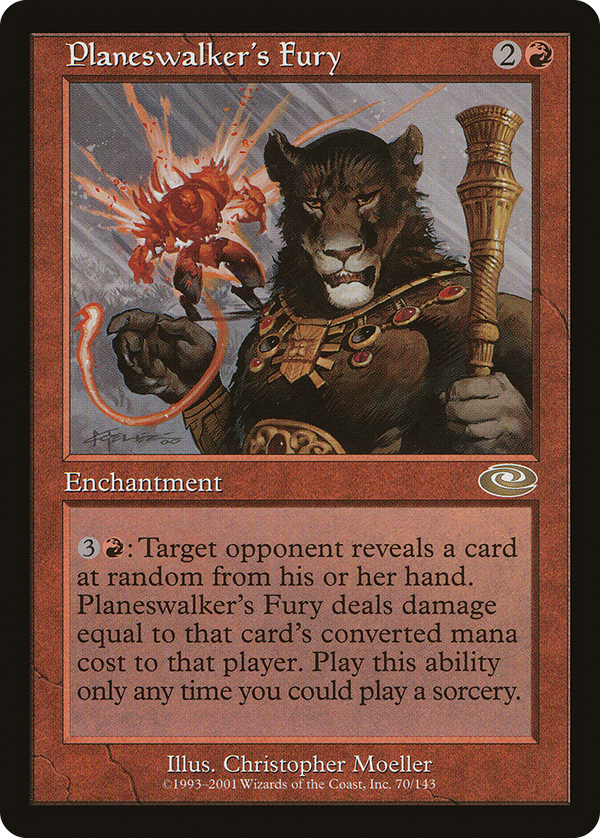
Rules text
 : Target opponent reveals a card at random from their hand. This enchantment deals damage equal to that card's mana value to that player. Activate only as a sorcery.