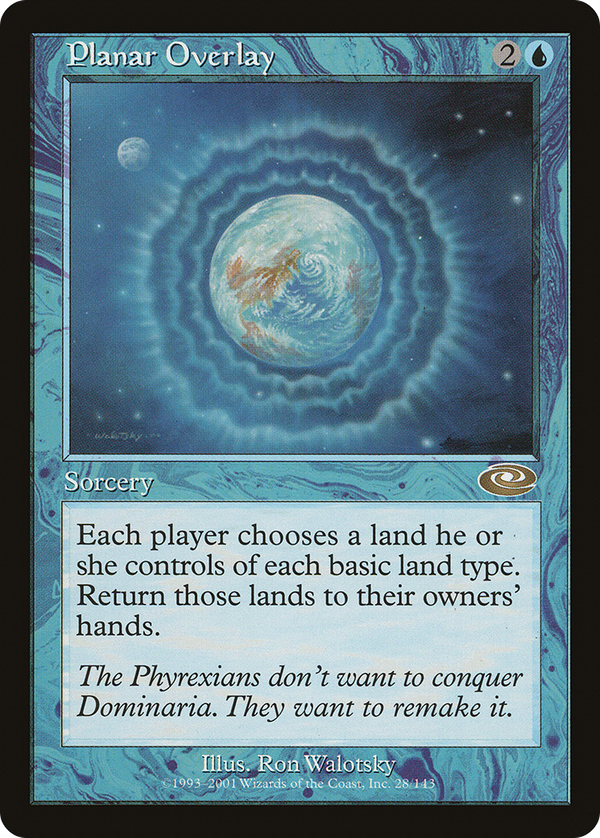
Planar Overlay


The construction reads symmetrical, but it almost never resolves symmetrically: it bounces by land type, not by land count, so the player whose manabase spans the most basic types gives back the most. A tight two-color deck loses a land or two; a deck assembling all five basic types to fuel a domain payoff or a five-color fixing base returns the entire rainbow at once. The "each player chooses" framing softens the blow without neutering it. Because every player picks among their own lands, an opponent never gets to pluck out a specific dual at will, but the choice is far from free: if your only source of a given basic type is a fragile multicolor land, you are forced to pick it and watch it bounce. The spell skims breadth off a manabase, and the greedier the manabase, the deeper the cut. That makes it a tempo answer rather than a hard one, a way to set a stretched fixer back a turn or two while leaving a disciplined two-color build largely intact. It is the punishment-side mirror of land-type-matters design, the counterweight to mechanics that rewarded a diverse manabase: the more types you gathered to power those payoffs, the more this clawed back. A precise and faintly mean piece of design that only looks fair if you ignore the greedy fixing it was built to tax.