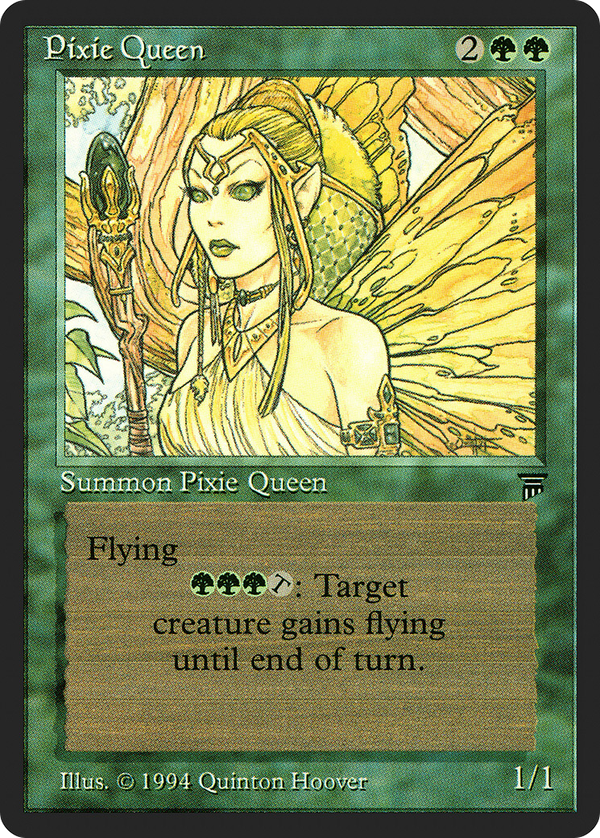
Pixie Queen


A useful window into how early Magic priced flexibility. The body is a 1/1 flier for four, already a poor rate by 1994 standards, and the activated ability asks for three green mana on top of the tap, paid every turn, to hand flying to a single creature until end of turn. That triple-green pip cost is the tell: the designers were not pricing this as a repeatable combat trick but as a ceiling-setter, a faucet that only opens when a mono-green deck has flooded hard. The card is doing two jobs that later design would split cleanly. The flying-granter role eventually went to one-shot auras and instants priced at one or two mana, where the rate could actually be evaluated. The repeatable creature-ability role went to creatures whose own bodies justified the inclusion, with the activation as upside rather than the entire pitch. Pixie Queen sits in the awkward middle, asking you to pay a premium for a fragile body to access an ability whose mana cost assumes you have nothing better to do with three green. The design instinct (a green flier that lifts the ground game into the air) is sound; the math, as with much of Legends, is not.
Rules text
,  : Target creature gains flying until end of turn.