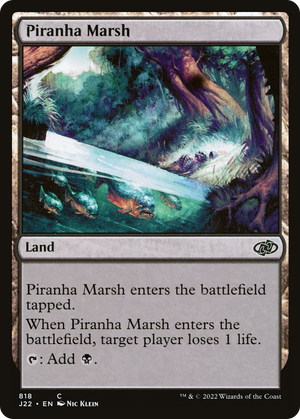
Piranha Marsh
The actual cost here is the entering-tapped clause: a turn of tempo surrendered on the way down, the standard price for a land that does anything beyond produce mana. What it buys is one point of life pried off a chosen opponent, and the honest question is whether that point ever justifies the lost momentum. It usually does not on its own. A point of life loss does not pressure a midrange opponent, does not meaningfully shorten a clock, and evaporates the moment anyone gains incidental life. The payoff is fixed and small by design, which is exactly why it belongs only in shells already committed to attrition: decks that win by accumulating tiny increments of life loss, where every source of reach counts and the manabase itself is expected to chip in. As a mono-black source it asks nothing more of the deck than tolerance for that entry tap, which is the entire reason a utility land like this gets built; the drain rides on top of fixing the card was going to provide anyway. Because the trigger targets a player rather than a creature, an empty board never strands it: there is always a legal aim across the table, the rare wrinkle being multiplayer politics where you might point it at yourself to ease tension. This is a land for a deck that has already decided incremental life loss is the win condition, and treats the land slot as one more trickle in that stream.
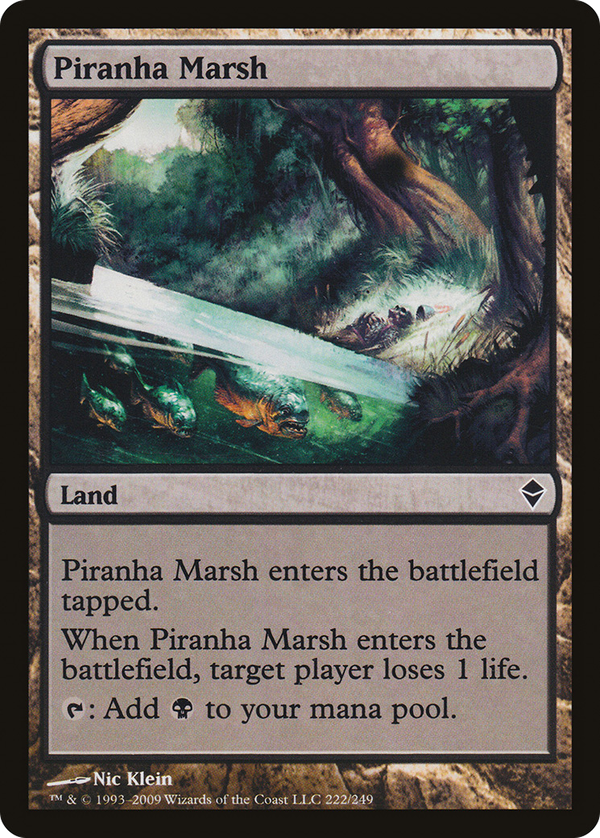
Rules text
 : Add
: Add  .
.