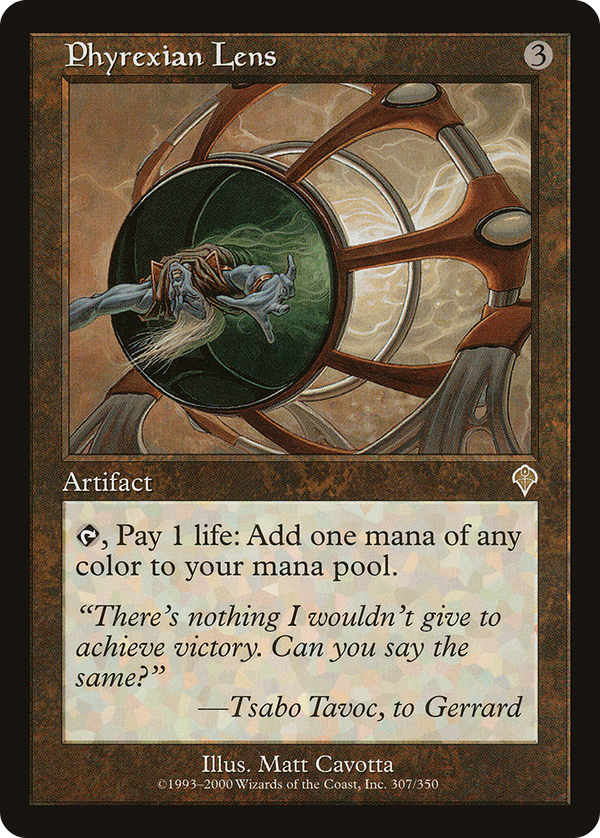
Phyrexian Lens

Three generic mana up front buys you nothing but a worse version of fixing that already existed, then keeps charging a life per tap. The City of Brass family fixes any color and takes a point to do it; this asks the same toll but spends a mana investment to set up and occupies an artifact slot rather than a land drop. The trade is supposed to be that an artifact survives land destruction and gives a colorless deck color access without committing a land to it, but the rate dates the card: by the time fixers like this were being printed, painless five-color lands were already the standard the format measured against, and paying both the front-end cost and the recurring life made it the strictly more expensive option in nearly every shell. What it represents is the early-era instinct toward multicolor design: artifacts built to enable the gold cards a set was assembled around, and this is among the bluntest of those attempts, a fixer with no upside beyond the fix. No ritual burst, no scaling, no second mode to justify the tax. It does "any color from an artifact" and stops there. That ceiling is why it stayed a footnote: the job was done cheaper before it arrived and done cheaper after.
Rules text
 , Pay 1 life: Add one mana of any color.