Phyrexian Grimoire

Repeatable graveyard recursion is supposed to function like a toolbox: pay the cost, surface the answer the board demands. This artifact inverts that premise by handing the selection to the person who least wants you to have a good card. Each activation costs  and the tap, returns exactly one card, and exiles whichever of the top two cards your opponent considers more dangerous in your hands. That clause is the entire design. The Grimoire reliably coughs up the card your opponent deems least threatening and torches the one you actually wanted, so you cannot fetch a specific answer no matter how badly you need it. The four-mana, tap-gated activation already makes this slow; ceding the choice makes it useless as a real engine. It comes from a school of early artifact design that priced powerful effects (recurring card advantage from the graveyard) behind friction so steep the rate rarely earned its slot. What stays interesting is the shape of the constraint. Rather than capping the power with a finality counter or a once-per-turn limit, the design caps it by ceding agency: the card you most want is the card you are least likely to see. That single inversion, opponent-as-selector instead of self-as-selector, is what kept a repeatable recursion artifact from ever becoming something you could build around.
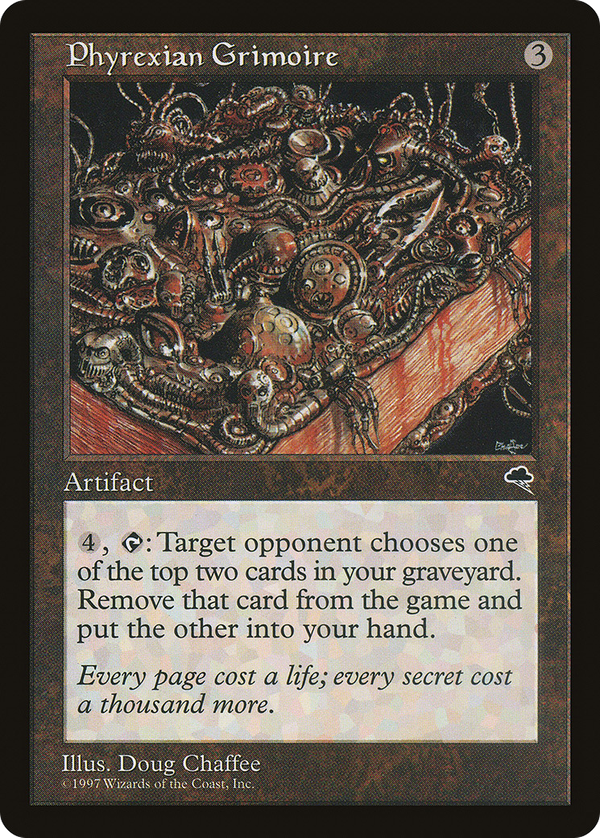
Rules text
,  : Target opponent chooses one of the top two cards of your graveyard. Exile that card and put the other one into your hand.