Phyrexian Etchings

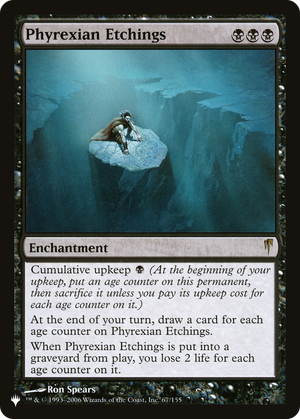
The clock runs in both directions, and the size of the bill is yours to set. The first upkeep adds one age counter, drawing one card at end step; the next draws two, then three, but the upkeep tax climbs in lockstep with the payoff, and the moment the enchantment dies, every counter you stacked costs two life apiece. Value front-loads and punishment back-loads. The intended line is to milk a burst of cards over a few turns, then let it go on a turn when the life swing no longer matters, ideally with a board that closes the game. This kind of self-terminating engine asks you to name the turn you walk away rather than letting an enchantment grind forever, and it states that idea about as plainly as black ever has: the resource it pays in is life, the resource black is happiest spending, and the death-trigger guarantees you never quite get the cards for free. The triple-black cost locks it to a dedicated deck, and the single-black-per-counter upkeep is slow-burn pressure rather than a sudden cliff: the mana stays affordable for a few turns, which is precisely what tempts you into letting the age counters (and the eventual life bill) pile higher than they should. What you buy is a few turns of explosive card advantage on a self-assessed tab, sized by how greedy you choose to be and how soon you cut the cord.
Rules text
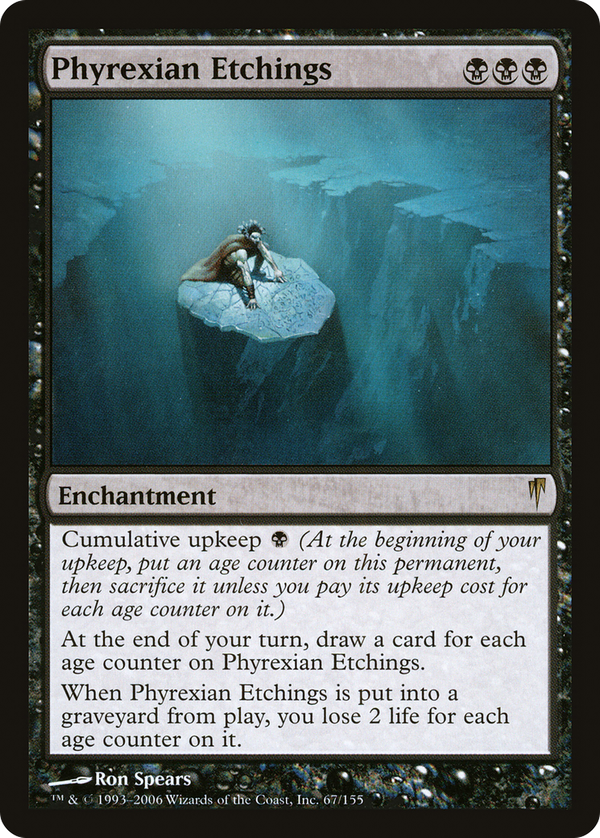
(At the beginning of your upkeep, put an age counter on this permanent, then sacrifice it unless you pay its upkeep cost for each age counter on it.)
At the beginning of your end step, draw a card for each age counter on this enchantment.
When this enchantment is put into a graveyard from the battlefield, you lose 2 life for each age counter on it.