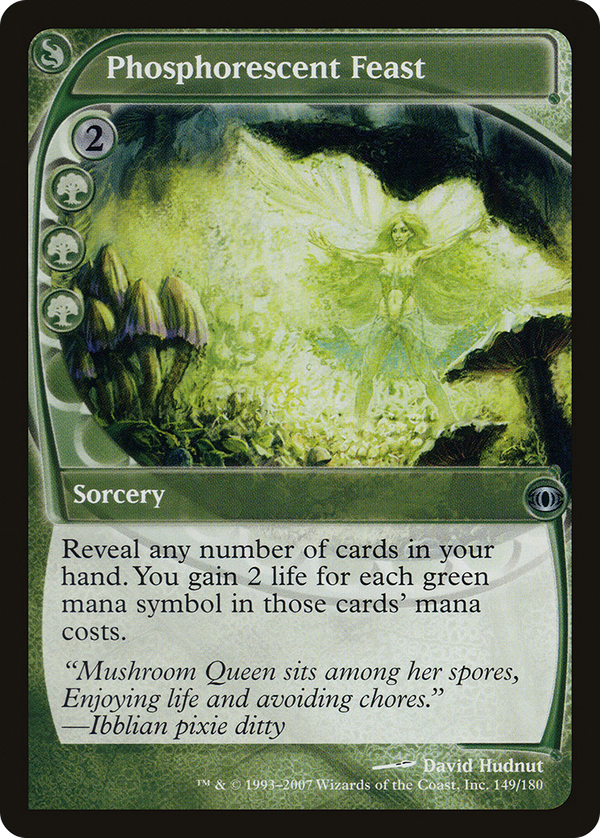
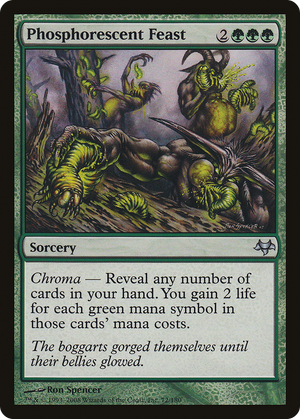
Phosphorescent Feast


Lifegain that scales with the green pips in your hand, not the cards on your board, makes this the deepest test of a single mechanic's central promise: that a deck saturated enough in one color could be paid for its saturation. A hand stuffed with green-heavy costs (creatures running multiple green symbols, the odd double or triple in a single line) turns this into a real lifegain spike; a splash of green pays almost nothing. That puts it a few years ahead of devotion's permanent-counting in spirit, but it counts the wrong zone, and the difference is the whole problem. Reading your hand rather than your board means two kinds of friction at once: the more green you reveal, the more you advertise what you are holding, and the more cards you keep in hand to feed the count, the slower you are actually developing. Five mana for life and no board impact is already a steep ask; the reveal makes it a tell. As an artifact of the era's chroma experiments, it is instructive precisely because it fails cleanly: it proves the mechanic could generate enormous numbers in a sufficiently committed green deck, and it shows exactly why hand-counting never anchored a competitive archetype while board-counting later did. The cards you reveal to power it are the cards you are not casting.