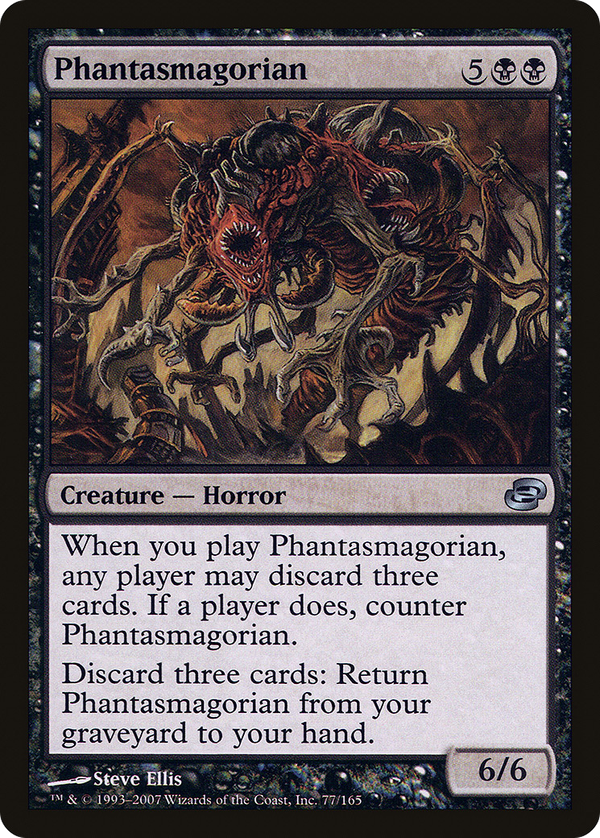
Phantasmagorian


The recursion clause is the whole reason this exists, and it is built for a graveyard you are actively trying to fill. Discarding three cards to buy it back from the bin looks like a steep tax until you read the cast trigger: when you put it on the stack, any player may discard three of their own cards to counter it. That clause tells you the design intent outright. This card never wants to resolve as a 6/6; it wants to sit in your graveyard as the largest, most reusable pile of discard fodder a black deck could ask for, pitched to fuel some engine and bought back to be pitched again. Almost every deck running it gets it into the graveyard by milling or discarding it, not by paying seven mana to cast a body that an opponent can erase for the price of three cards they were probably happy to dump anyway. The cast trigger doubles as a sanctioned, cheap way for opponents to dispose of it during the rare game where the creature matters at all, an unusual concession that tells you exactly how little the horror was meant to attack and block. Strip it down and the line returning it from the graveyard is the entire card: a self-replacing discard outlet, a fuel cell for any loop that cares about cards leaving your hand or entering your graveyard, with a finisher's body bolted on as an afterthought nobody intends to use.