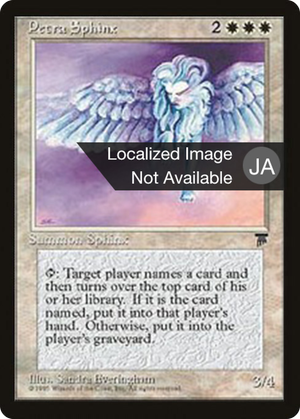
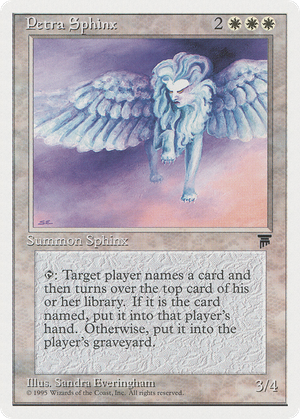
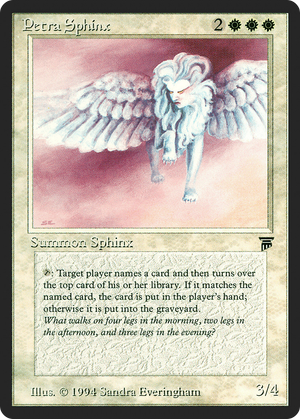
Petra Sphinx


A diagnostic engine dressed as a fair-rate creature, and a window into how early design thought about information. The crucial wrinkle is that the targeted player names the card, not the Sphinx's controller: that single line of attribution is what makes the ability so strange to use. Point it at yourself and it becomes a controlled draw, since you name what you have stacked on top and pull it into hand. Point it at an opponent and the math inverts: they choose the name, so a player who knows their own top card simply names it and draws, turning your activation into free card selection for them. The ability only bites when the named card and the revealed card disagree, which means the opponent must be either ignorant of their own library or forced into a wrong guess: a condition that rarely arises by force. Triple-white on a five-mana 3/4 is the rate Legends reserved for build-arounds rather than role-players, and the Sphinx sits in that bracket beside the set's other heavily restricted utility creatures. The mechanic has not aged well as a competitive tool, but the underlying idea, an ability whose cost is paid in another player's information rather than in mana, is one early Magic kept circling. Petra Sphinx is the rare case where that price lands on the wrong side of the table, which is exactly what makes it a museum piece worth studying.
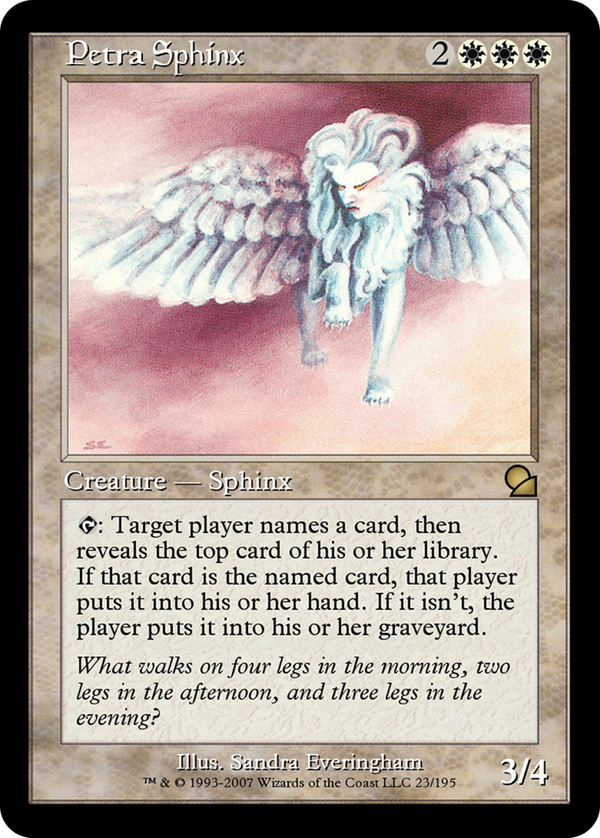
Rules text
 : Target player chooses a card name, then reveals the top card of their library. If that card has the chosen name, that player puts it into their hand. If it doesn't, the player puts it into their graveyard.