Perpetual Timepiece

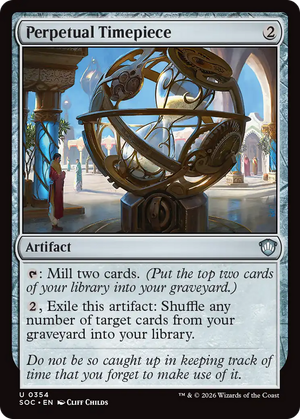
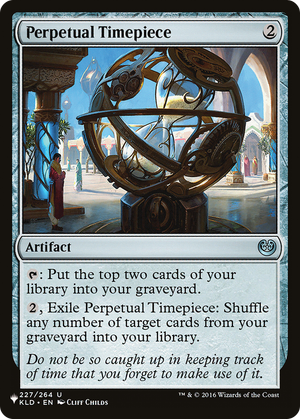
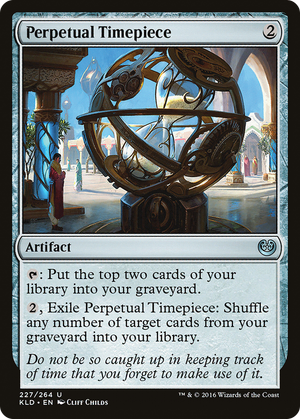
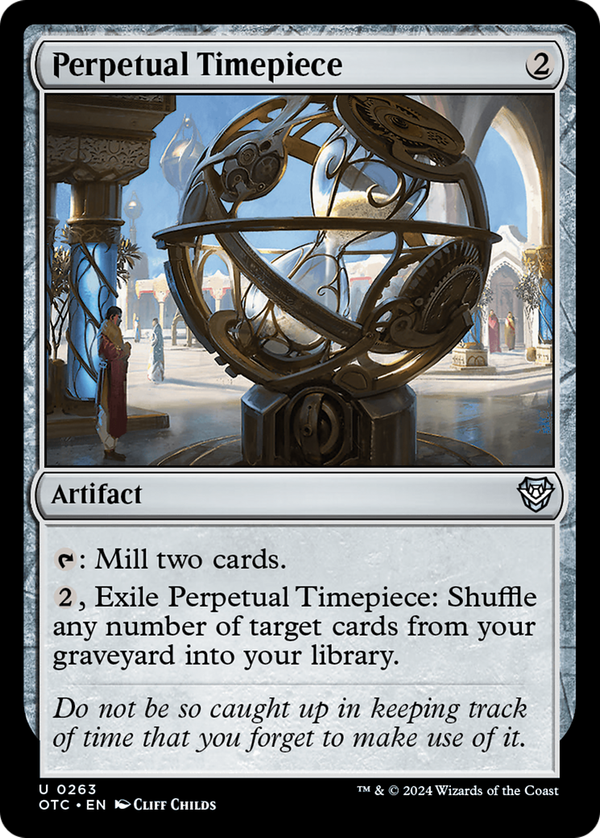
Self-mill is usually framed as a cost: a deck dumps cards to enable graveyard payoffs, accepting the risk that the pile gets exiled out from under it. This artifact treats the graveyard as a holding account that can be emptied back into the library on demand. The tap ability tops up the pile two cards at a time, but the rescue clause is where the design lives. By exiling itself, it shuffles any number of cards from your graveyard back into your deck, which makes it a one-time answer to graveyard hate rather than a renewable engine. The interaction window is what matters: when an opponent aims an exile-your-graveyard effect at you, you can respond by tucking the threatened cards into the library where the spell cannot reach them, turning a blowout into a reshuffle. The self-exile cost is the discipline here. You buy exactly one rescue, and you forfeit the mill engine to pay for it, so it can never sit on the battlefield as permanent insurance. That leaves it in a strange middle: not a recursion loop, since it fires once, and not a clock, since the mill only ever touches your own library. It is a single, colorless escape hatch for graveyard-centric decks that have everything to lose the moment someone tries to make their pile disappear.
Rules text
 : Mill two cards. (Put the top two cards of your library into your graveyard.)
, Exile this artifact: Shuffle any number of target cards from your graveyard into your library.
: Mill two cards. (Put the top two cards of your library into your graveyard.)
, Exile this artifact: Shuffle any number of target cards from your graveyard into your library.