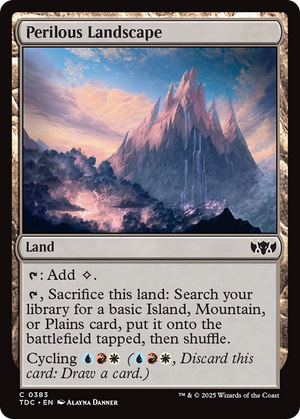
Perilous Landscape
The trick here is that the sacrifice ability fetches a basic tapped rather than searching for a nonbasic, which means it thins the deck and fixes across three colors without ever costing life. That puts it in the same structural role as a fetchland, but the tradeoff is inverted: no shockland or dual to grab, no life paid, and the color it produces on its own is colorless rather than untapped mana of a specific color. What makes it worth the deck slot in the first turns of a game is the colorless tap, and what makes it worth the slot in the late game is cycling. A land that draws a card when you no longer need lands solves the perennial problem of flood without asking you to run fewer sources; the 

 cycling cost simply names the three basics it also fetches, so the card stays honest to its Jeskai identity in both modes. This is the design lineage that started with cycling lands and gradually merged with fetch effects: a single slot that is untapped colorless early, a basic-fetcher when you need to hit land drops or thin, and a cantrip when the board no longer wants more mana. The name of the game with a card like this is redundancy of function within one card, and it collapses three different roles that older decks needed three different cards to fill.
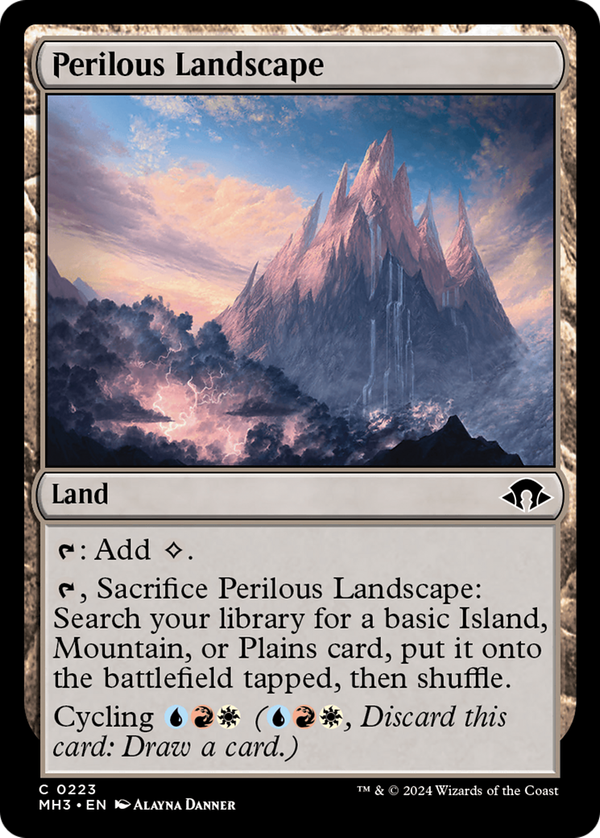
Rules text
 : Add
: Add  .
, Sacrifice this land: Search your library for a basic Island, Mountain, or Plains card, put it onto the battlefield tapped, then shuffle.
Cycling (, Discard this card: Draw a card.)
.
, Sacrifice this land: Search your library for a basic Island, Mountain, or Plains card, put it onto the battlefield tapped, then shuffle.
Cycling (, Discard this card: Draw a card.)