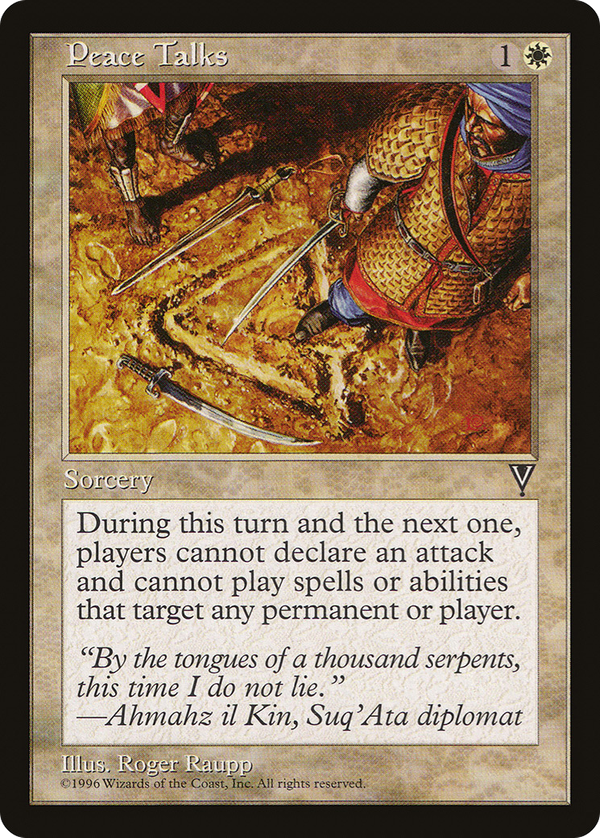
Peace Talks


A Fog that buys two turns instead of one, and refuses to discriminate about whose attacks it stops. The two-turn window is the design idea worth dwelling on: most pacifism effects last a single combat, so the card answers a race by freezing it for both players, which means the caster has to want the board locked rather than just survive an incoming swing. The targeting clause does the heavier lifting and points in a stranger direction. Making players and permanents untargetable by spells and activated abilities is a symmetric protection shell, a defensive wall thrown up across the whole table that shuts off removal, burn to the face, pinger activations, and any aimed spell or activated ability for the duration. That shell cuts both ways, which is why the card reads as a pure tempo-neutralizer rather than a setup piece: you cannot point your own spells at anything either. Where most white control tools answer one threat, this answers a whole category of action at once, then hands the same protection to your opponent. What restrains it is exactly that symmetry plus the two-turn cost on your own development; you spend a card and a turn to stop combat and targeting by spells and activated abilities for everyone, and you have to be the player who profits from a frozen, untargetable board. A design that reads cleanly and plays awkwardly, which is usually the mark of an effect Wizards printed once to see what it did.