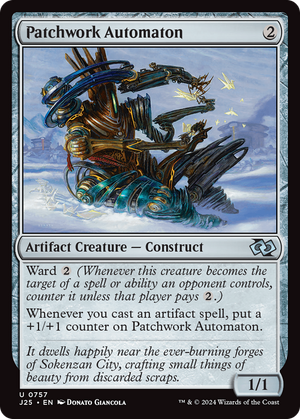
Patchwork Automaton

The counter arrives when you cast the artifact, not when it resolves, and that timing choice is where the design finds its quiet aggression. A countered Mishra's Bauble still grows this creature; so does an artifact spell that fails to stick for any other reason, because the trigger cares only that you cast an artifact, never about its cost or eventual fate. That decouples the clock from the board, letting a deck already firing a wave of cheap artifacts for value assemble a threat from the same spells it wanted to cast. The ward is what converts the growth from incidental to genuinely dangerous. Every counter it accumulates becomes an investment an opponent has to overpay to unwind: a 1/1 carrying a two-mana tax is barely worth answering, but that same tax attached to a much larger body often buys a full extra turn, because the cheapest removal no longer clears it profitably. The card asks a builder to commit hard to artifact density, then repays that velocity twice: with a body that stops chump-blocking and starts closing, and with a tax that prices out the interaction meant to punish an all-in curve. Its ceiling tracks how many artifact spells the shell casts regardless of this creature's presence, which pushes it toward low-to-the-ground affinity-adjacent builds that measure every artifact by how fast it can be cast.
Rules text
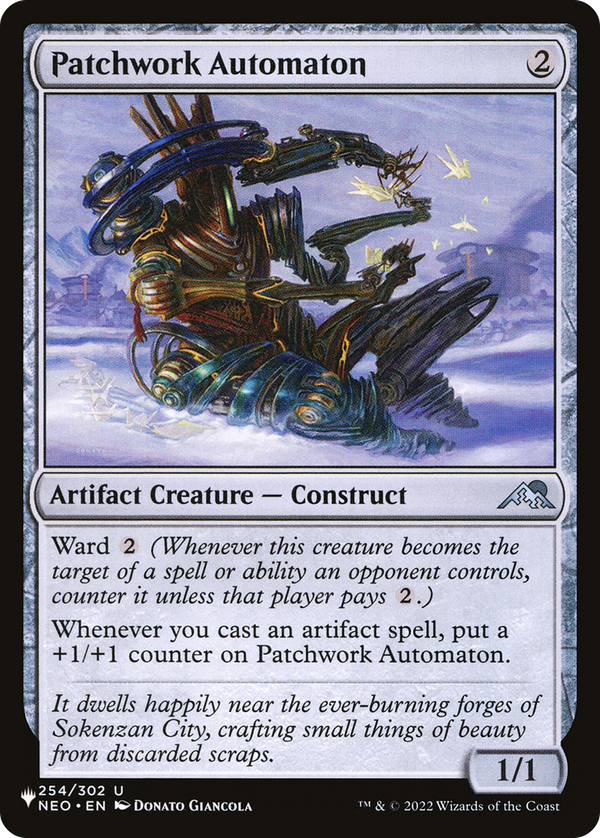
(Whenever this creature becomes the target of a spell or ability an opponent controls, counter it unless that player pays .)
Whenever you cast an artifact spell, put a +1/+1 counter on this creature.