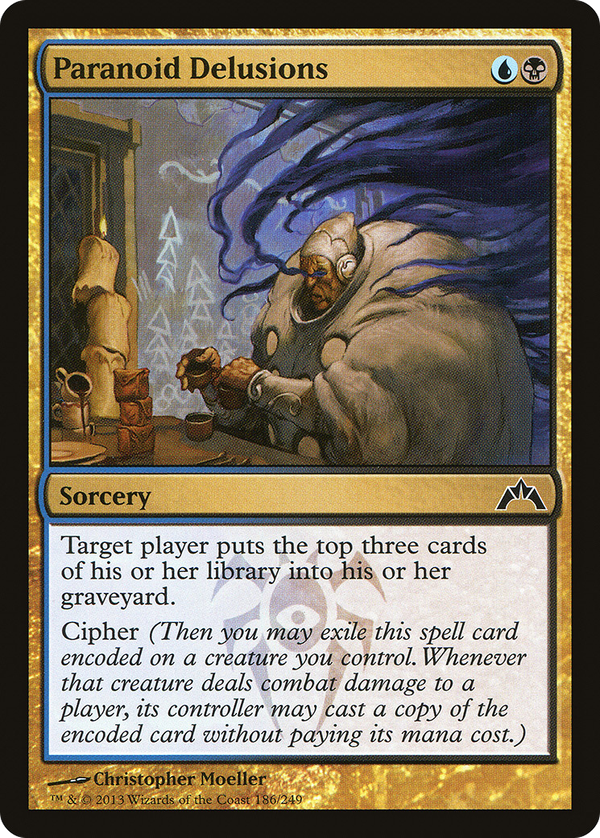
Paranoid Delusions


Cipher attached to a mill spell is a deliberate pairing: the keyword that wants to recur, fused to an effect where recurring it is the whole point rather than overkill. Three cards as a one-shot is trivial, but cipher's design logic is to convert combat damage into free recastings, and a small grinding mill is one of the few payloads where "do it again next combat, and the one after" reads as a clock rather than redundancy. Encode it onto an evasive creature and each connection mills three more off the top. The rate is linear, not exploding: the original card stays encoded on the body, each combat trigger lets you cast one copy, and nothing compounds. The library just erodes a fixed three at a time, as long as the creature keeps getting through. The window is tighter than it looks. Cipher encodes the moment the spell resolves, so casting it before combat means the encoded attacker can connect and trigger the copy on that same turn; the engine does not idle waiting for a setup turn. The real tax is creature dependence: this is an attrition plan wearing a sorcery's clothing, hostage to every removal spell and blocker between the encoded body and the opponent's library. Mill here is slow grind, not burst, and the spell only ever matters if you can string combat steps together, which is precisely the behavior cipher was built to reward.