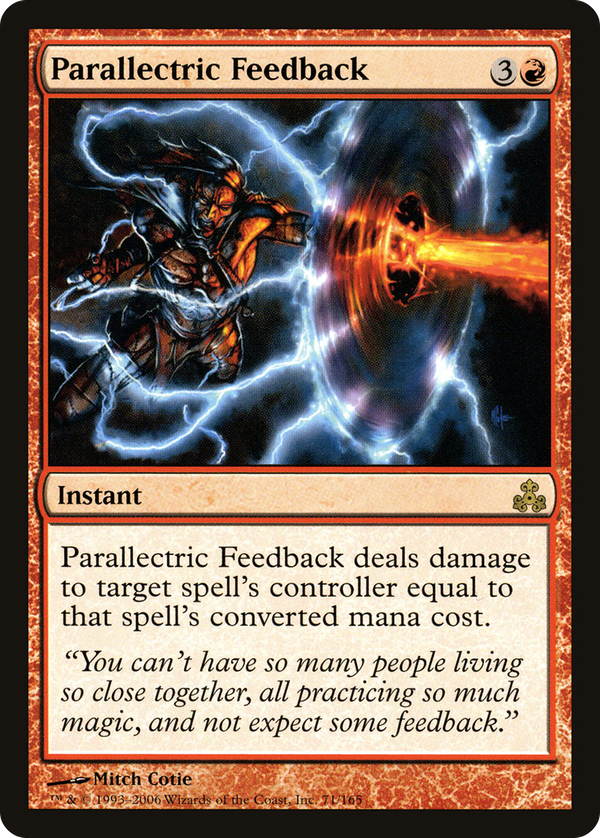
Parallectric Feedback


The punisher here is the opponent, not you: cast this in response to a spell and the damage scales to whatever they were trying to resolve, turning their own ambition into the weapon. The design is a clean inversion of how most counter-magic is priced. Where a hard counter charges you for the privilege of denying a big spell, this charges them, and it gets better the more they overcommit. Answer a one-mana cantrip and you have wasted your turn; catch an opponent untapping into a seven-drop and you have dealt seven to the face for four mana. That asymmetry is the whole engine. It does not stop the spell from resolving, so it is no help against a lethal threat or a game-ending combo piece; it is a tax on the act of casting, payable in life. The effect is a curiosity precisely because it refuses to behave like the cards it sits near: it is neither removal nor permission, but a wager that the table will reach for something expensive. Red rarely gets to interact on the stack at all, and when it does the interaction usually means redirecting or copying, not punishing mana value directly. Here the color gets a priority window to point at a spell still waiting to resolve and bill its controller by the pound: a punisher that only profits when the opponent's plan is grand enough to hurt them.