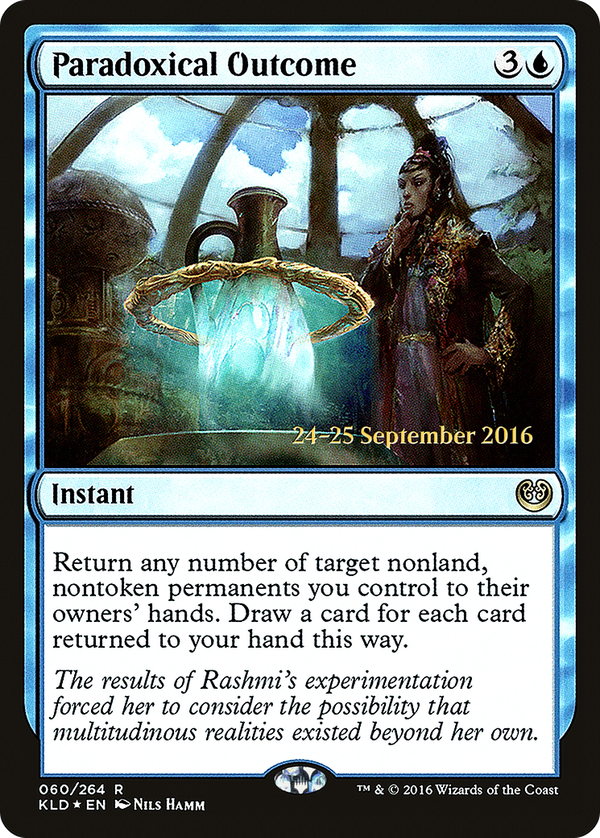
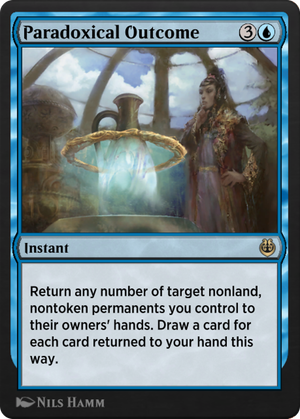
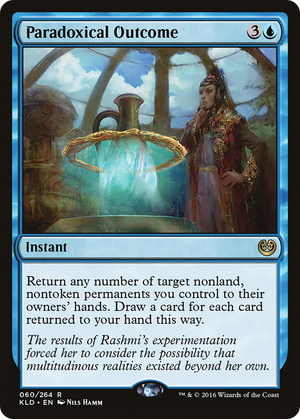
Paradoxical Outcome


The engine is the trade it offers: every nonland, nontoken permanent you bounce to hand draws you a card, and because the permanent itself also comes back, each return nets two cards in hand at instant speed. On paper that reads like a value spell; in practice it is a combo enabler, because the permanents you return are not meant to stay in hand. They are zero-cost and near-zero-cost mana artifacts, the Moxen and their kin, that you replay immediately to refill the board and net mana in the process. Returning ten cheap rocks and drawing ten while paying yourself back most of the mana is how this becomes a draw-your-deck loop rather than a four-mana cantrip. The genius and the danger both live in the symmetry of the count: the card cares only about how many permanents you returned, not what they cost, so the cheaper your artifacts the more brutally the math compounds. This is why it has lived its competitive life in the most artifact-dense formats in the game, the ones where a critical mass of free mana rocks is actually buildable, and why it has never been a fair-deck role-player. It demands a board already brimming with cheap permanents to justify the four mana, and rewards that demand with a payoff that scales past any reasonable ceiling. Being an instant matters too: holding it up as insurance against removal turns a value spell into a threat a sorcery could never be.