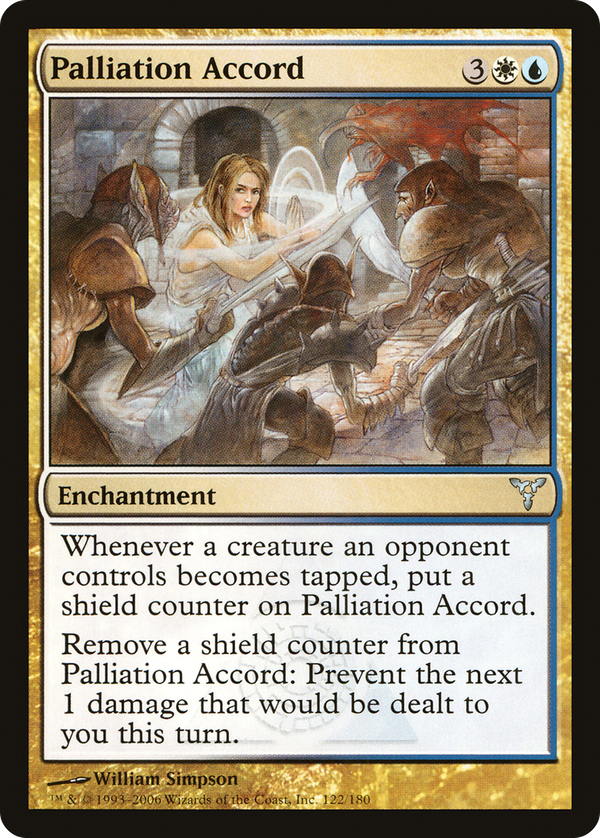
Palliation Accord



The conditional turns an opponent's tempo into your insurance policy: every creature they tap to attack or to activate an ability adds a counter, and every counter is a point of incoming damage you can erase later in the turn. The trick is the disconnect between when the counters arrive and when they spend. The enchantment banks charges off enemy tapping but only redeems them against damage to you, which means it does nothing against an opponent who never commits creatures and quietly stockpiles against one who does. Against an aggressive board it reads like a slow-building wall: the more they attack, the less their swings hurt. And because the activation carries no per-turn or per-source limit, you can crack several counters in response to a single threat, draining a built-up reserve all at once to blunt a large attacker. The white-blue control shell this was built for wanted exactly that kind of attrition piece, a prevention engine that fed on the opponent's own aggression rather than on your card economy. What dulls it is the single-target restriction (only damage to you, not your creatures or planeswalkers) and the dependence on opponents actually tapping out, so the reserve fills on their schedule, not yours. It is a design more interesting than its rate: a feedback loop where the resource you spend is generated by the very thing you are defending against, an elegant closed circuit that rarely keeps pace with a serious clock.