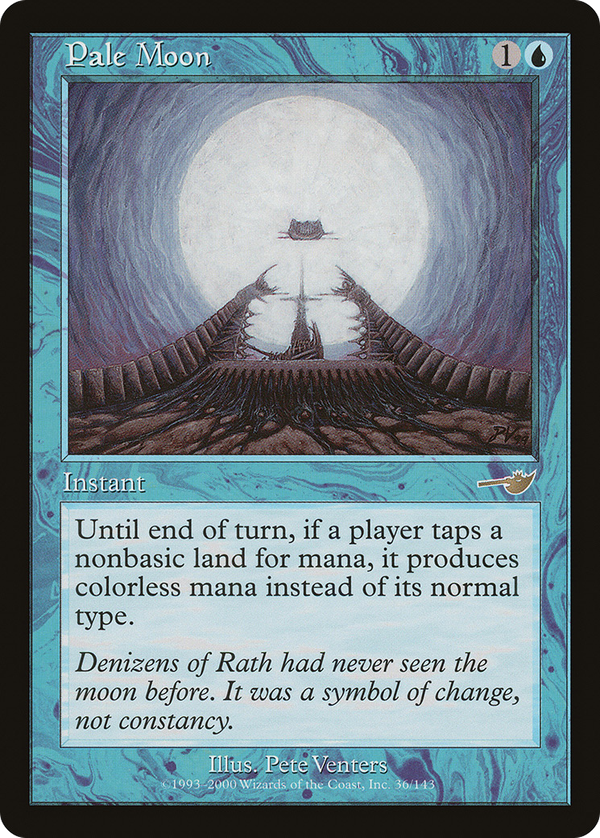
Pale Moon


The most pointed answer ever printed to the dual land, and a piece of design that only makes sense in a world where nonbasic mana bases had grown decadent. It destroys nothing and counters nothing; it attacks the assumption that your lands produce the colors printed on them. Resolve it, and every nonbasic on the battlefield pays out colorless until end of turn: a shockland, a filter land, a painland, or any rainbow-fixing nonbasic gives up the color it was supposed to make. The discipline that defines it is timing, and the trap is the same window. Mana abilities never use the stack, so you cannot wait for an opponent to tap a land in response to a colored spell; the effect has to be standing before they reach for mana at all, which means casting it on the opponent's own turn, during their upkeep or draw step, before the colored land ever taps. Because it lasts only through the current turn, casting it on your own turn does nothing to their next one. Its great limitation is also its honesty. Basic lands shrug it off entirely, so the better-fixed the deck, the harder it lands, and the card punishes exactly the ambition it was built to check. The design idea (mana that exists but cannot be spent on what you intended) stayed rare because it is feel-bad and matchup-dependent in equal measure. What it represents outlasts what it does: a referendum, in instant-speed form, on how much your lands are quietly bluffing.