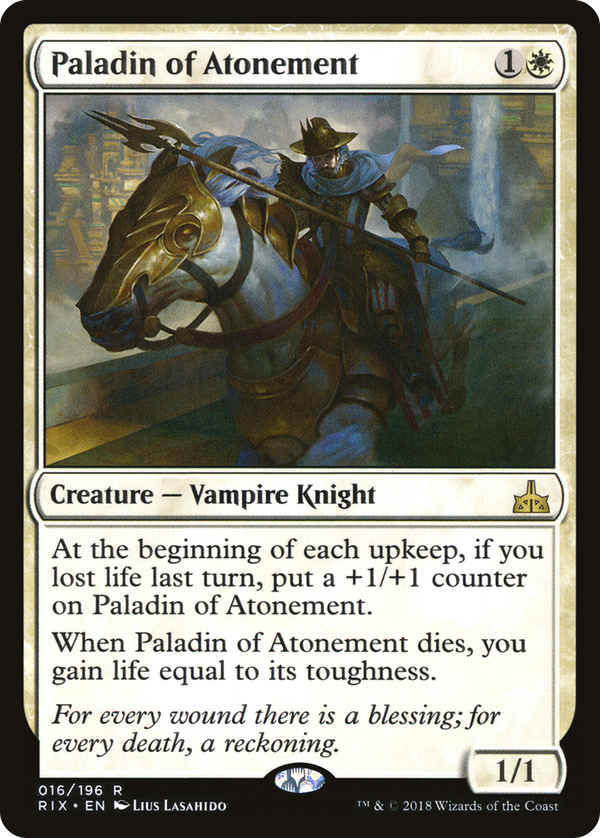
Paladin of Atonement


The design premise here is a body that grows by turning your own life total into a resource, and the trigger is deliberately binary: it does not care how much life you lost last turn, only that you lost some, so it lays exactly one counter per upkeep no matter how hard you bled. That framing matters, because it rewards a steady drip of self-inflicted loss rather than a single big payment. The costs it counts are the ones a deck already pays for its manabase and its engines: shocklands entering untapped, painlands filtering colors, fetchlands cracking, and any effect that makes you pay or lose life on your own turn. Unblocked or trample combat damage you take counts too; creatures dying in your own blocks do not, since combat losses to your creatures are not life loss for you. What makes the shell coherent is the death clause paying back the accumulated toughness as life, which reverses the usual math on removal: the more counters it has stacked, the more life its controller stands to gain when it dies, so killing the large version funds the very engine it was feeding. That turns it into an awkward attacker to trade with and a natural payoff for a deck built to spend life on purpose, converting a running tab of small self-inflicted wounds into both a clock and a cushion that grows on its own timetable.