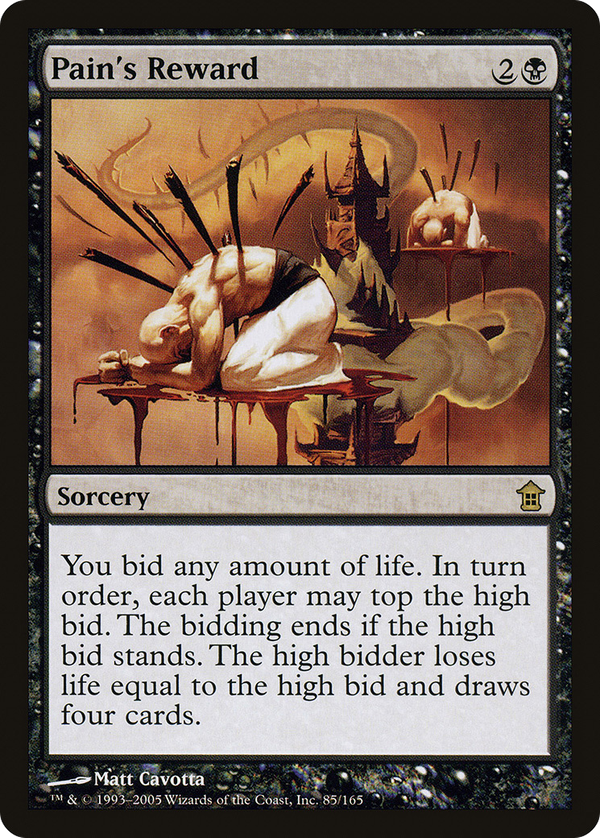
Pain's Reward


An auction for cards, settled in life, is one of the rare effects that puts the cost itself up for negotiation. The card promises four cards to whoever wants them most, but the price is set by the table, not the spell: you open the bidding, and each opponent in turn gets a chance to top you. Either someone pays more life than you are willing to and takes the draw, or the bid stands and you pay your own number. That makes it a genuinely political instrument rather than card advantage with a fixed downside. The interesting tension is that the controller has no special authority over the outcome: you choose the opening figure, but the loop of topping the high bid means an opponent at a high life total can simply outbid you and walk away with the cards, leaving you having gained nothing but a turn spent. Designs that hand the steering wheel to opponents like this tend to live in a specific niche: tables where life totals are deep enough that the four cards matter more than the points, and where reading how badly each player wants to draw is the whole game. It belongs to the small family of group-decision spells that treat life as a bidding currency, an idea the game has returned to sparingly because the result is so dependent on who is sitting across from you.