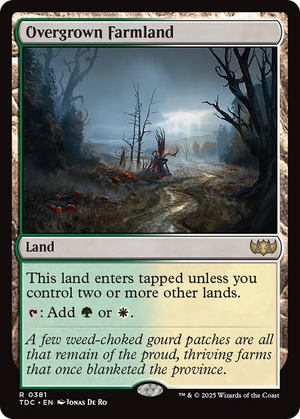
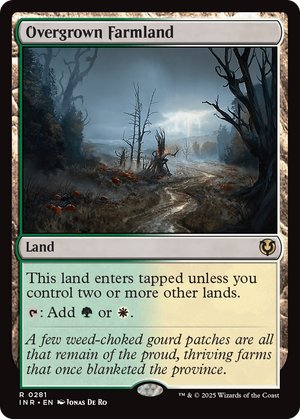
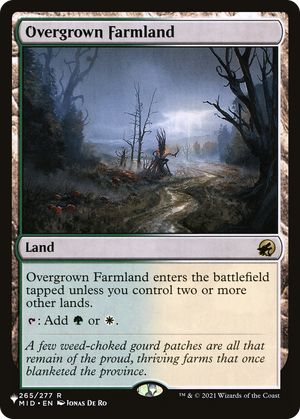
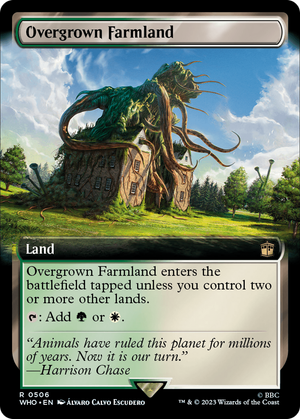
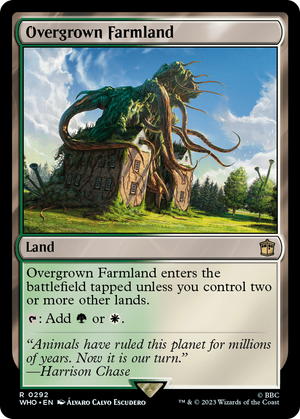
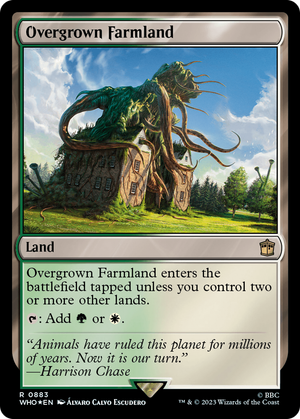
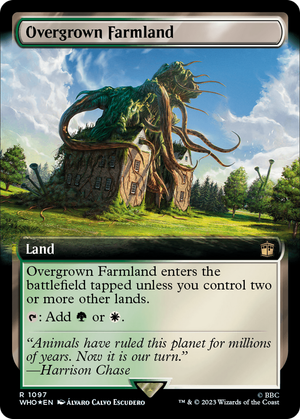
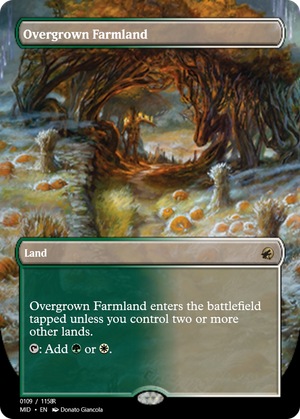
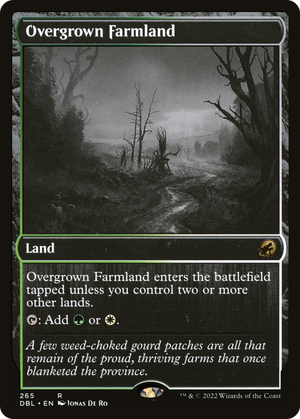
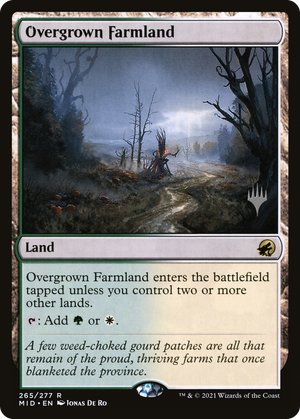
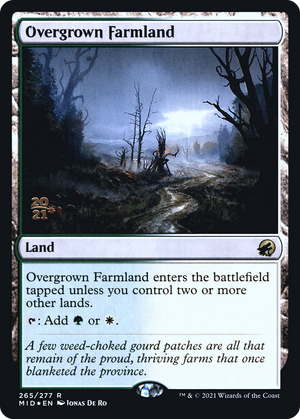
Overgrown Farmland
Older dual lands forced a binary: enter tapped every time (a guaranteed early stumble) or pay life on entry to arrive untapped. This design threads the two by making the tapped clause conditional on your land count rather than on the turn or your life total. When you control fewer than two other lands, it enters tapped, which is a real tempo cost: it can strand a one- or two-drop you meant to cast on curve, and only careful sequencing (leading on basics, holding the dual for a later land drop) recovers those turns. From the third land onward, the penalty is gone entirely, and it produces either half of its color pair with no life paid and no strings attached. What it gives up for that clean profile is the basic land types the older typed duals carry: it cannot be found by a fetchland, so decks built around fetch-heavy manabases pay for the untapped upside in reduced tutorability. This slow-land template appeared across the two-set Innistrad block as a full ten-card enemy-and-ally cycle, a self-contained answer to the tapland problem that pushes its cost into precisely the window a well-built curve can plan around. It is not a shape that has been reprinted often since, which makes the cycle a discrete experiment rather than a recurring house standard: a dual whose price is paid in early-game friction and lost fetchability, not in life or in a permanent tempo tax.
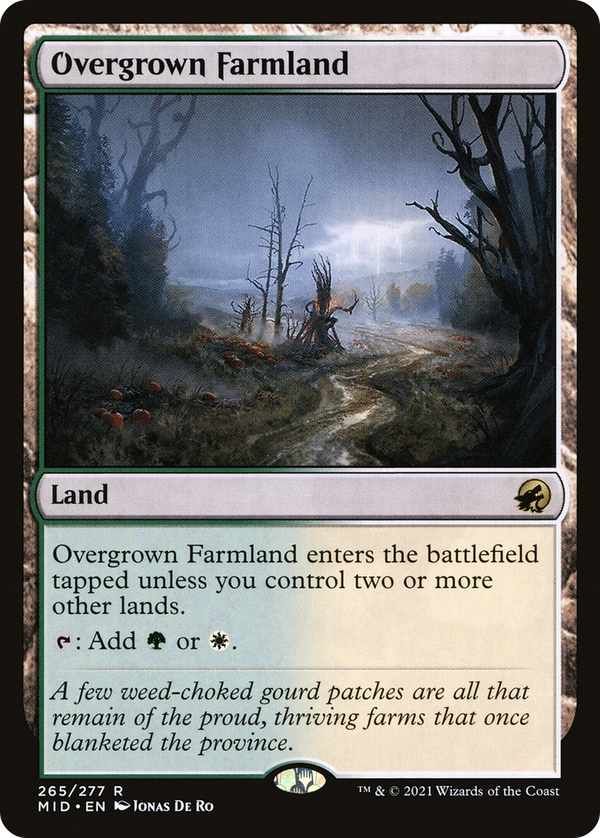
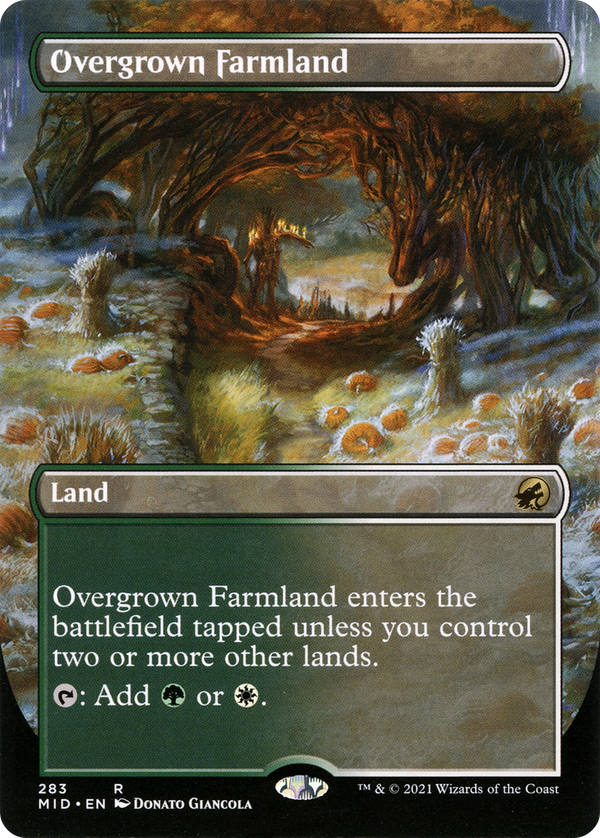
Rules text
 : Add
: Add  or
or  .
.Format Status
More formatsFewer formats
Other printings
- Tarkir: Dragonstorm Commander#381
- Innistrad Remastered#281
- The List#MID-265
- Doctor Who#506
- Doctor Who#292
- Doctor Who#883
- Doctor Who#1097
- Magic Online Promos#94098