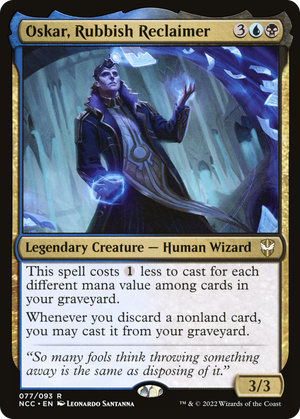
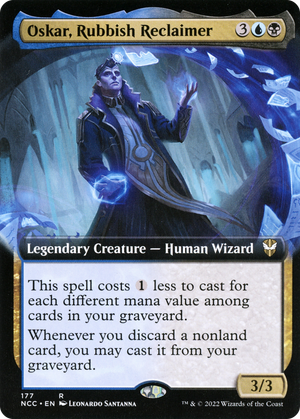
Oskar, Rubbish Reclaimer



Discard is normally a cost you pay; here it becomes a trigger you exploit. Every rummaging spell, every looter, every "draw two, discard two" turns into a way to pitch a nonland card and recast it straight from the graveyard, so the discard side of card selection stops being a loss and starts being a launch point. The mana matters here: you still pay the recast cost, so what the yard preserves is the card, not the spell's price. That keeps the loop honest and pushes the deck toward holding mana open and sequencing discards deliberately rather than dumping the hand and hoping. The self-discount clause sits on an unusual axis for a graveyard payoff. Most reward volume, the raw count of cards milled; this one rewards range, the spread of distinct mana values sitting in the yard. A pile of two-drops does nothing, while a scatter of ones, threes, fives, and sevens shaves the cost toward its floor, which quietly rewrites how you build the graveyard: variety over redundancy. The lineage runs through blue-black recursion commanders that treat the graveyard as a second hand, but this one is lighter and more combo-adjacent, wanting you to churn hand and yard constantly rather than grind a single loop. The 3/3 body is incidental. What defines the card is the network of discard outlets built to feed it.
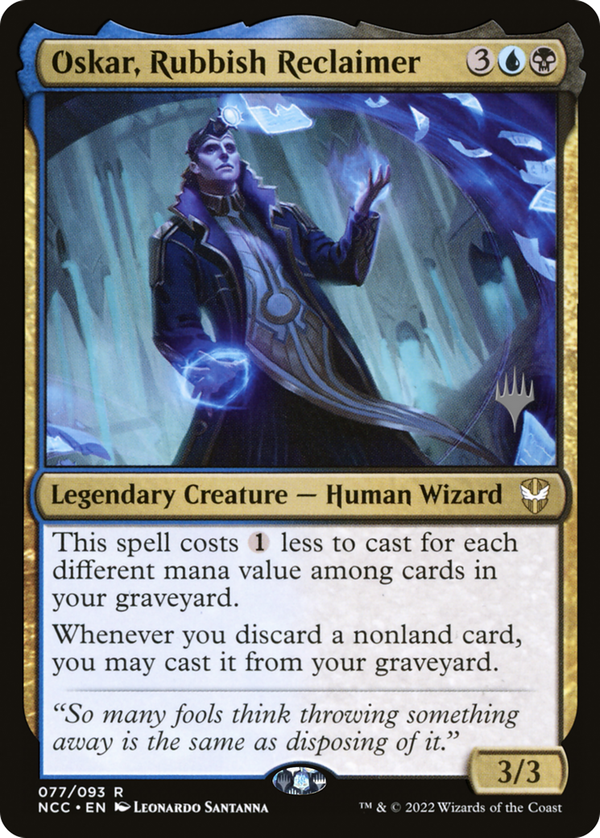
Rules text
 less to cast for each different mana value among cards in your graveyard.
Whenever you discard a nonland card, you may cast it from your graveyard.
less to cast for each different mana value among cards in your graveyard.
Whenever you discard a nonland card, you may cast it from your graveyard.