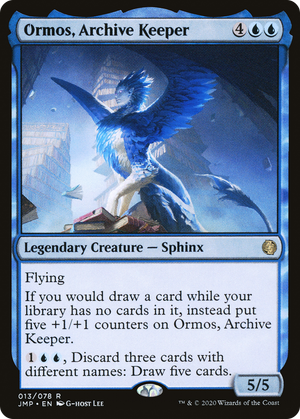
Ormos, Archive Keeper


Most self-mill payoffs treat an empty library as a countdown to a loss trigger; this Sphinx flips the sign on it. The replacement clause turns the moment your deck runs dry into a growth spurt: the draw that would kill you instead loads five +1/+1 counters onto a 5/5 flier, quietly repositioning a control finisher as a mill deck's insurance policy. That is the wrinkle worth building around, and the discard outlet is what gets you there. Pitching three differently named cards to draw five is a rate only fair decks would blink at; a deck stocked with singletons treats the discard as pure velocity, digging deep enough to empty the library on purpose and then leaning on the replacement effect to keep the wheels from coming off. Ormos answers the question that haunts every draw-your-deck build (how do you go all-in without the last draw step being the thing that beats you) by making the point of no return the point where the body becomes lethal. The "different names" clause is the honest tax on all that raw card flow, steering the card toward high-variety, low-redundancy piles rather than a stack of identical enablers. It is a value threat and a milestone in the same slot: the card that draws you toward decking and then rewards you for arriving.
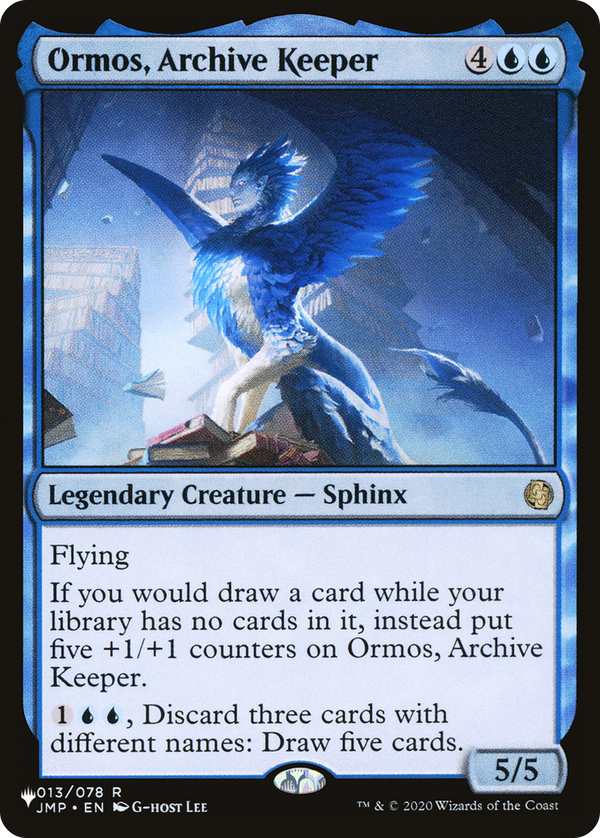
Rules text
 , Discard three cards with different names: Draw five cards.