Oreplate Pangolin


The optional payment is the whole mechanism here: the counter doesn't accrue for free, it costs you a mana each time an artifact lands, which turns a two-drop into a mana sink you can lean on whenever the rest of your hand is dry. That "may pay " is a deliberate throttle on the growth: in a deck spitting out cheap artifacts the trigger fires constantly, but the tax means you can't grow the Pangolin and develop your board in the same breath. You're choosing, turn by turn, between a bigger threat and a wider one. The design sits in a long line of artifact-count payoffs stretching back through the various affinity and metalcraft experiments, but where those tended to reward a static board state, this one rewards throughput: the counter only lands when something new enters, so the card wants you replaying, blinking, and recasting artifacts rather than merely owning them. As a two-power body on turn two it's a fine beater on its own, and every artifact you'd already be playing quietly offers to make it a little bigger, one flexible mana at a time.
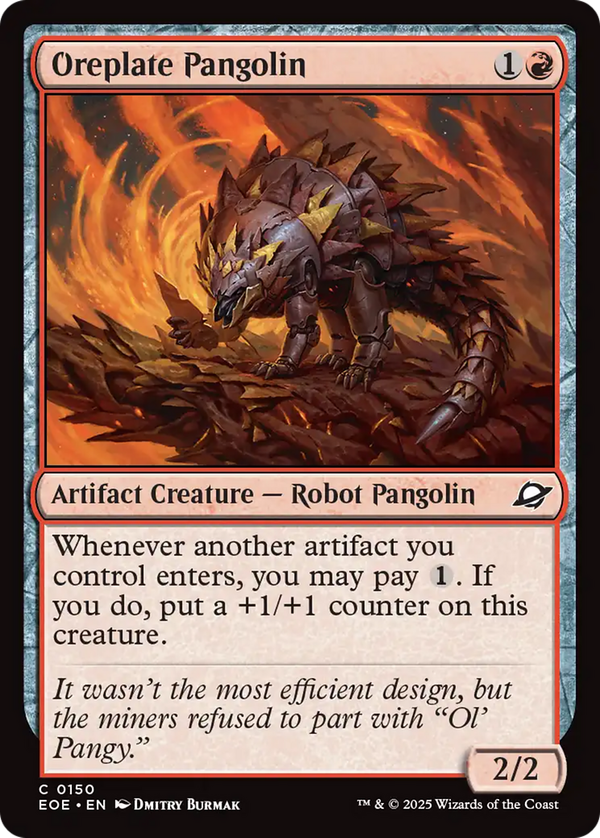
Rules text
. If you do, put a +1/+1 counter on this creature.