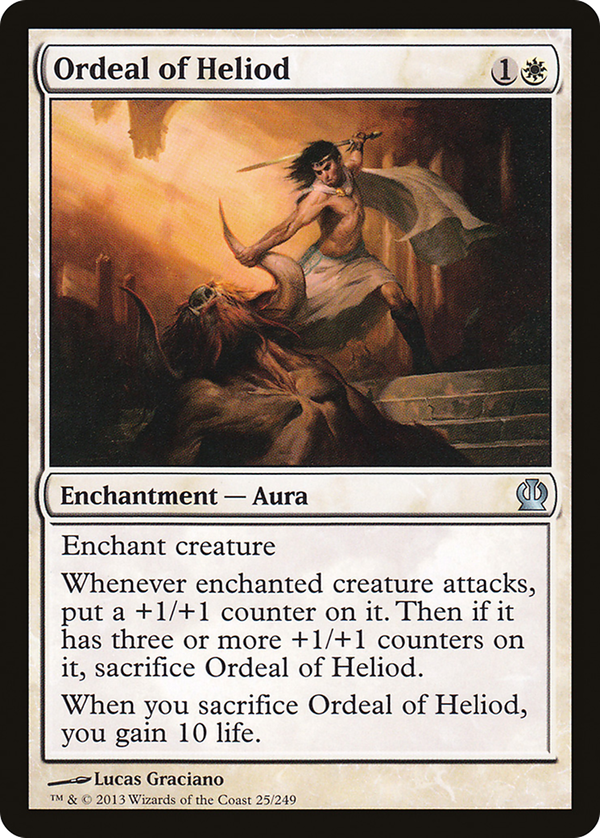
Ordeal of Heliod


The bargain runs in two stages with two different payoffs, and the design wants you to want both. The early game uses this Aura as a cheap pump, each attack adding a counter until a one-drop becomes a real threat worth a 3/3 of stats with no further investment. The back half is the actual reward: when the Aura is sacrificed, ten life pours in, enough to reset an aggressive race single-handedly or buy a turn against burn. The tension is that the two halves pull against each other. The aggro deck that wants the counters has to swing three times to cash out the lifegain, by which point the race may already be decided, while the deck that mostly wants the ten life would rather not telegraph a fragile attacker for two turns first. The wrinkle that loosens that bind is in the wording: the sacrifice clause checks whether the enchanted creature has three or more +1/+1 counters total, not whether this Aura put them there. Drop it on a creature already carrying two counters and the very next attack hands you the full ten immediately, the Aura spent in a single combat instead of three. That short-circuit rewards a deck already built around counters rather than treating Ordeal of Heliod as a standalone pump. As color identity it is white doing what white does: trading board tempo for the long game, with the lifegain held in reserve as the price for committing first.