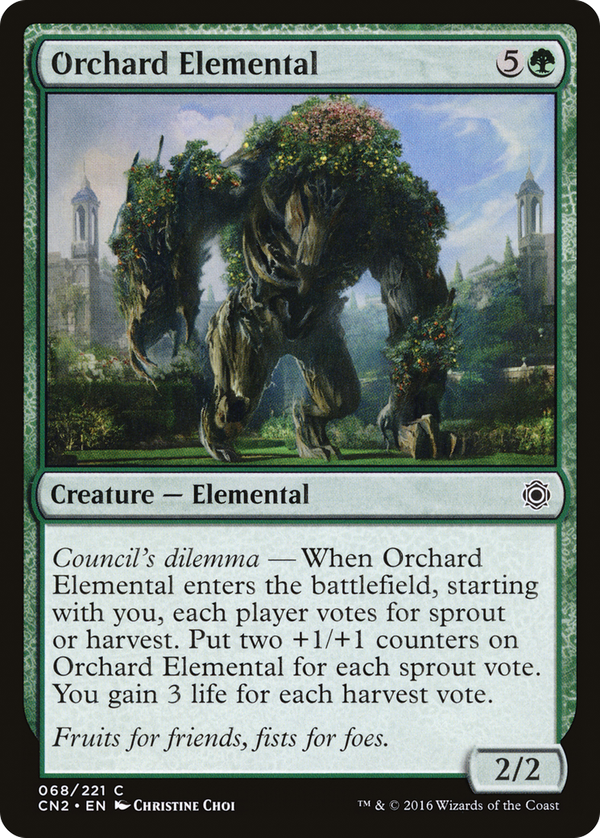
Orchard Elemental


Vote for sprout and this becomes a growing threat; vote for harvest and its controller pads a life total instead. That binary is the whole point, and it is calibrated to be as low-stakes as a voting card gets. Both outcomes land on the controller no matter how the table breaks: opponents are not choosing who benefits, only whether the 2/2 gets meaner (two +1/+1 counters per sprout vote) or the controller walks away with three life per harvest vote. Because the controller votes first and counts like anyone else, the creature never resolves as a dead blank. The design logic is in how mild both options are. Neither result frightens anyone, and that flatness is deliberate: when both branches are unthreatening, the decision turns on politics and threat assessment rather than reflexive fear, players weighing how much they resent the controller against how big they are willing to let a body grow. As a creature in a vacuum it is forgettable, a slow six-mana body whose size is outsourced to a vote. As a study in how these voting effects get tuned, it is the deliberately readable low end, the version where the dilemma was meant to be a genuine judgment call rather than a lopsided binary that resolves itself. It only functions where multiple players are voting, which is the only place it was ever designed to be cast.