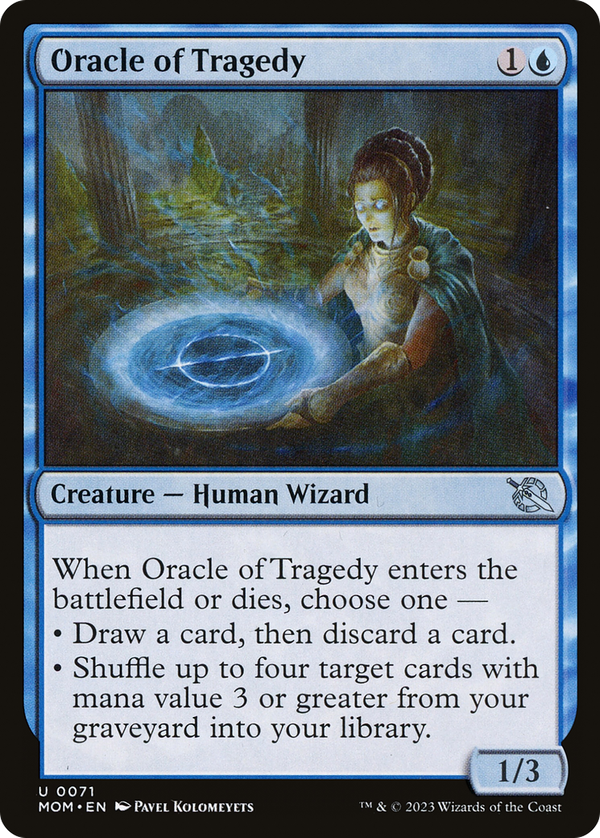
Oracle of Tragedy


The trick is that a single deployment pays out twice: once when it enters, once when it dies, and each trigger lets you pick the mode that fits the moment. On arrival, the loot mode digs toward a draw or pitches a fatty into the yard; on death, the recursion mode reaches back for up to four heavier cards and tucks them into your library. That symmetry is the design's spine. The 1/3 body is small enough that trading it away reads less as a cost than as a delivery mechanism, so the card actively wants to die, and it wants to die into a graveyard already stocked with expensive spells worth retrieving. The mana-value-three-or-greater clamp on the shuffle mode is the balancing wire: it will not scoop your cheap enablers, only the payoffs, which nudges you toward a build with real top-end to reclaim. Read one way it is a two-mana looter with a stubborn block; read the other way it is a reusable graveyard-to-library conveyor that resets your bombs and shrugs off exile-based graveyard hate by shuffling cards into the deck rather than leaving them where they can be answered. The loot mode is selection, not card advantage: it filters your hand without refilling it. The advantage lives in the dies trigger, which turns each death into a fresh loop of recursion for a deck that stacks its graveyard on purpose.