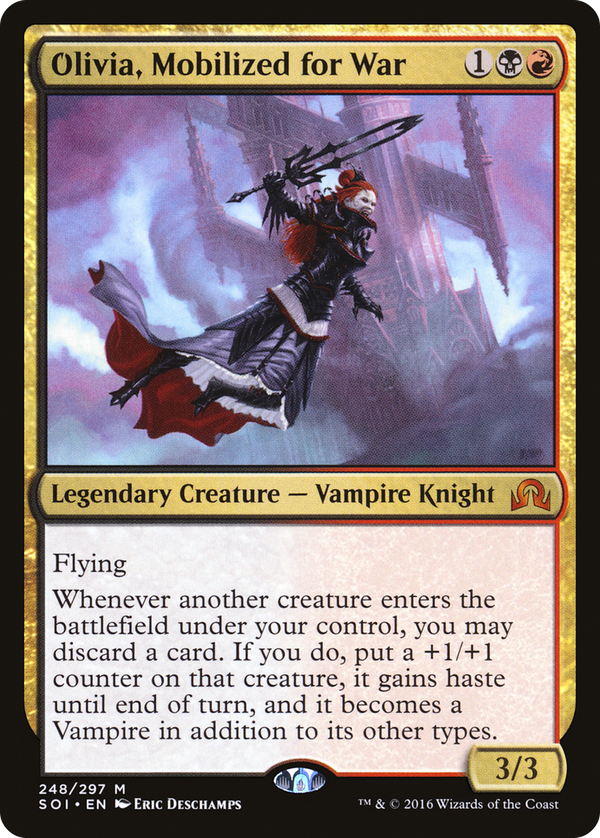
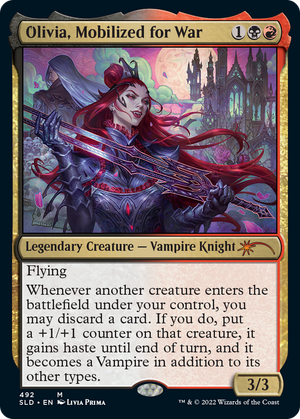
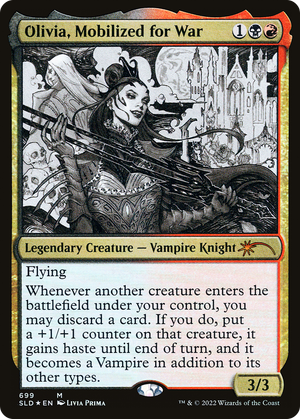
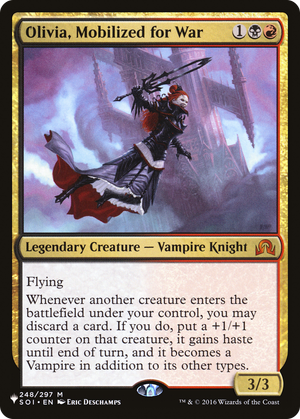
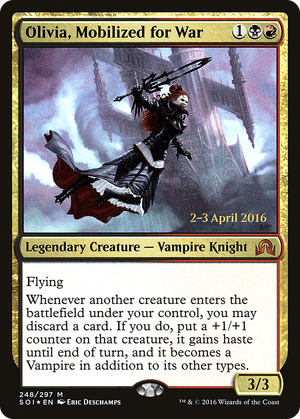
Olivia, Mobilized for War



The discard isn't a cost grafted onto a payoff: it's the engine itself. Every creature you play becomes a chance to pitch a dead card, and what you pitch back doesn't matter unless your deck is built to want cards in the bin. That single line of text reorients an entire color pair. A token-maker, a recursion target, a graveyard reanimator: each one feeds the trigger, and the trigger rewards exactly the kind of deck that flooded the graveyard on purpose. The counter and haste turn the freshly-played creature into an immediate threat rather than a future one, collapsing the usual gap between deploying a body and attacking with it. The Vampire-typing rider looks incidental until you notice it's doing tribal glue work, conscripting your whole board into a creature type whether or not it started there.
What keeps the design honest is the discard requirement: the trigger does nothing without a card in hand to feed it, so the engine runs only as long as you have fuel and stops the moment you're hellbent. That tension is the whole point. Earlier Hellbent designs wanted an empty hand and had nothing to spend it on; this asks you to empty your hand a card at a time and pays you in board presence each time you do. The body underwrites all of it: a 3/3 flier for three mana is a fair clock that never needs the engine to fire to justify the card. The aggro-aristocrats hybrid it enables (sacrifice value, reanimation, and a beatdown clock sharing one trigger) was unusual for a three-mana legend to hold together so cleanly.