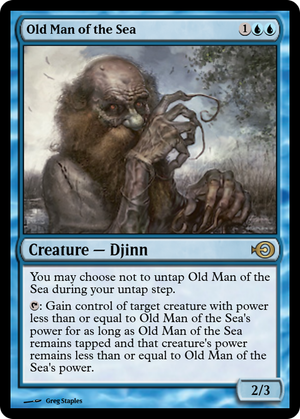
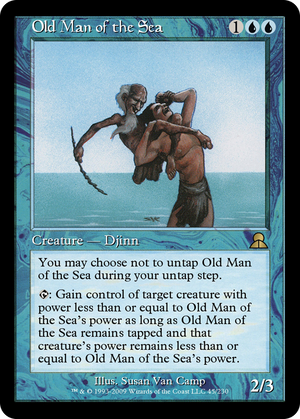
Old Man of the Sea


The optional-untap clause is the design pivot, and it is doing far more work than the rate suggests. By severing the assumption that creatures refresh every turn, the card converts its tap ability into a durational lock: the stolen creature stays stolen exactly as long as the thief stays sideways, which means the controller is choosing, every untap step, to keep paying the opportunity cost of a 2/3 left out of combat. That is a remarkably modern piece of design language to find on a 1993 card. The power-comparison clause adds a second, quieter discipline: the theft persists only while the target's power stays at or below this creature's own, so any pump effect, any counter, any aura that pushes the stolen creature past the Djinn's power breaks the leash. The threshold is not a fixed number but a moving comparison, which means pumping the Old Man itself can widen the range of legal targets even as the lock holds. Built into a three-mana Djinn, this is a control element with two independent failure modes baked in, and it models conditional, maintenance-based control of an opposing permanent rather than a one-shot effect, an idea the game would not formalize cleanly for years. The lineage from here runs through every "gain control as long as" card Magic has printed since; most of them owe their template, and their balancing instincts, to the constraints this card worked out first.
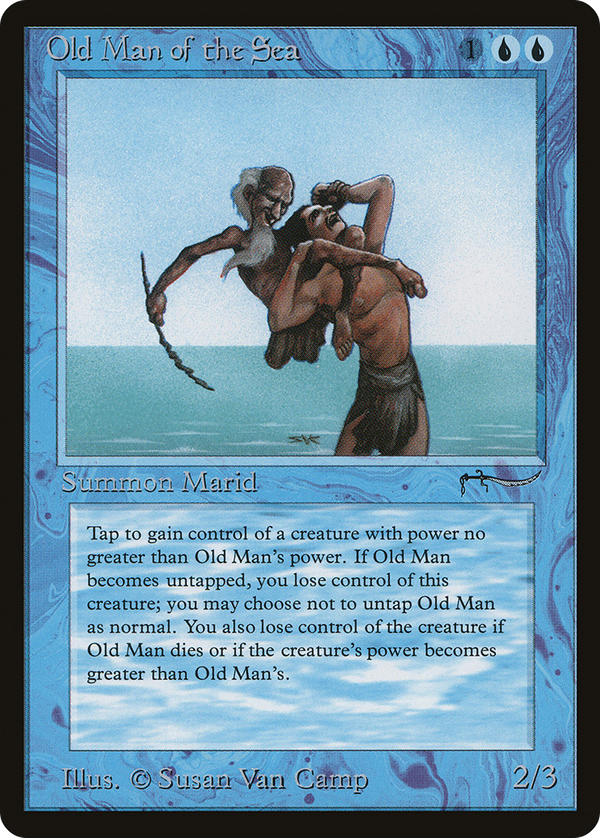
Rules text
 : Gain control of target creature with power less than or equal to this creature's power for as long as this creature remains tapped and that creature's power remains less than or equal to this creature's power.