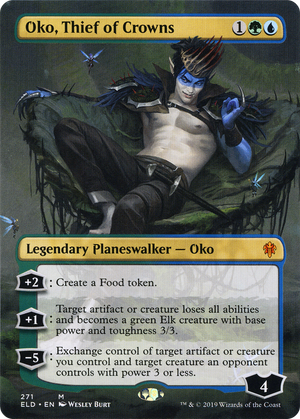
Oko, Thief of Crowns



The number that broke it was three. Every planeswalker before had been priced with the assumption that four loyalty and three mana bought you a plan, not a lock; this one plus-ones the moment it arrives and immediately protects itself by turning the biggest threat on the board into a vanilla 3/3, ability-stripped, no evasion, no keywords, nothing. The Elk clause is the engine that made it a menace: it is repeatable, it hits creatures and artifacts alike, and it neutralizes not just the body but everything the card was doing, from equipment to combo pieces to opposing planeswalkers' escorts. The Food side reads like value filler and functions as a loyalty battery, keeping Oko above the range most decks could threaten while the Elk half kept the board flat. The ultimate almost never mattered; a card that plus-ones to a stable, self-defending advantage does not need one. It ran through Standard and every eternal format it touched fast enough to draw one of the shortest ban windows in the game's history, pulled from Standard, Pioneer, Modern, Legacy, and Brawl in short order and restricted in Vintage. The design lesson stuck: it is the reference point for how badly a planeswalker's plus can go when it both advances and defends in the same activation, and Wizards has cited that failure mode implicitly in the more conservative loyalty math on nearly everything printed since.
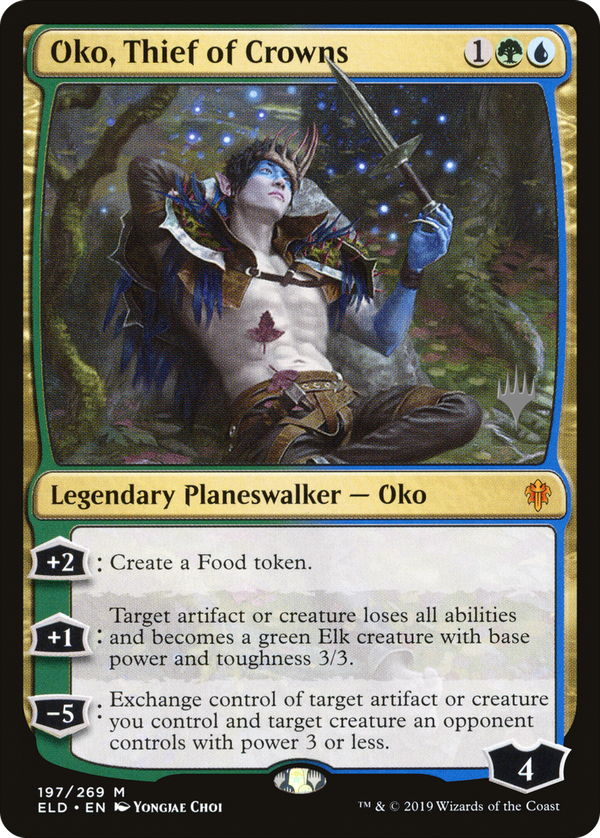
Rules text
 ,
,  , Sacrifice this token: You gain 3 life.")
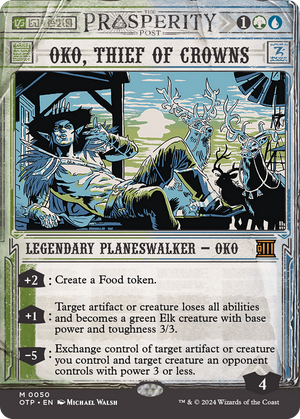
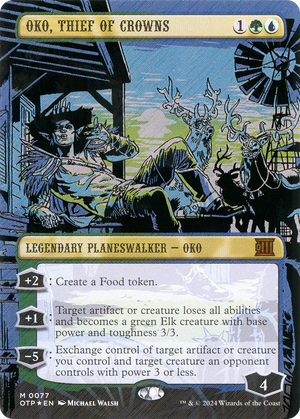
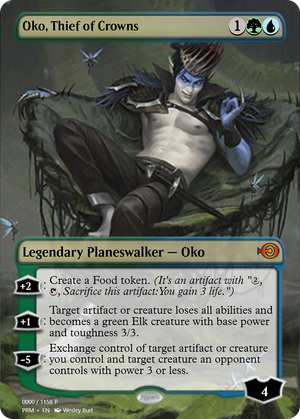
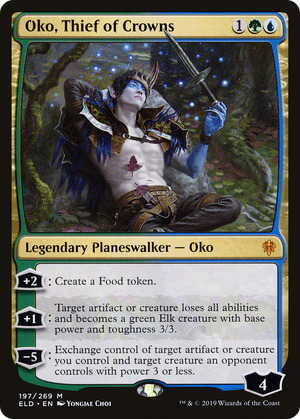
+1: Target artifact or creature loses all abilities and becomes a green Elk creature with base power and toughness 3/3.
−5: Exchange control of target artifact or creature you control and target creature an opponent controls with power 3 or less.
, Sacrifice this token: You gain 3 life.")
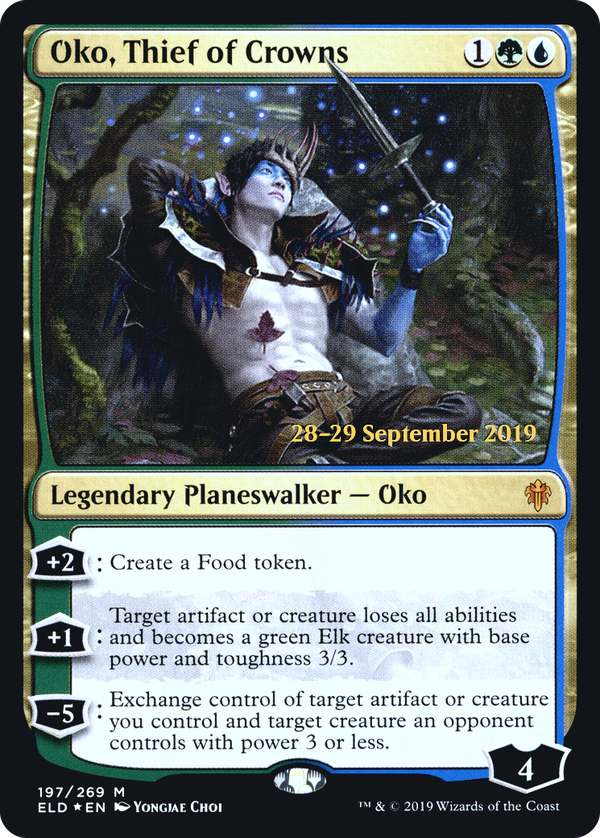
+1: Target artifact or creature loses all abilities and becomes a green Elk creature with base power and toughness 3/3.
−5: Exchange control of target artifact or creature you control and target creature an opponent controls with power 3 or less.