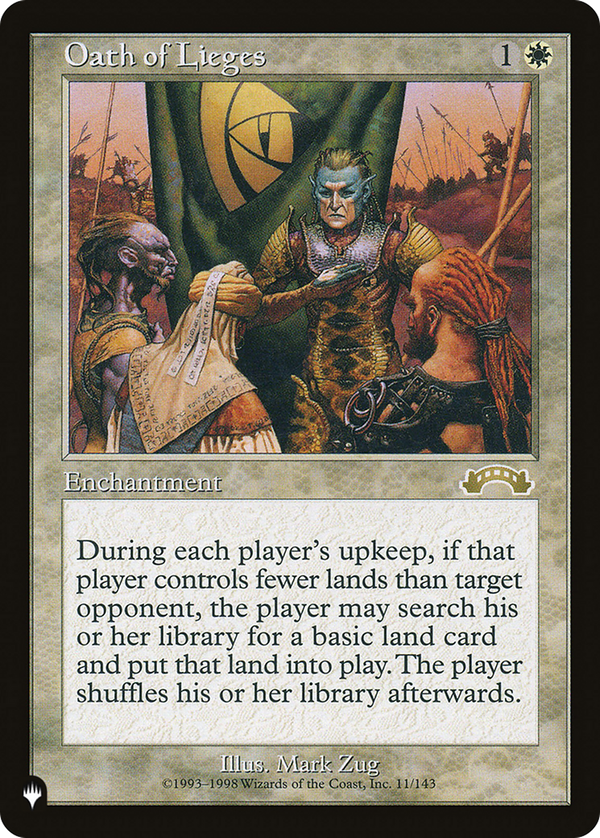
Oath of Lieges


Pure catch-up design, built around a question Magic rarely answers head-on: what happens when one player falls behind on mana? The enchantment hands the trailing player a free basic land each upkeep, but only if they are behind, and only against an opponent who is ahead. The trigger fires on every player's turn, so this is a symmetric ramp engine that bends toward whoever is losing the lands race, with the catch-up shutting off the moment parity is reached. That self-correcting clause is the entire point: the card cannot run away with a game because it stops feeding you the instant you stop being behind. It works to compress the board state rather than spike it, a deliberate counterweight to the usual ramp logic where the player already ahead pulls further ahead. The downside is that in a one-on-one race it can keep an opponent's mana topped up too, since the trigger does not care whose enchantment it is. What makes the card durable as a design artifact is the targeting language: it requires an opponent who controls more lands, which means in a multiplayer game the question of who is "ahead" becomes a live negotiation every upkeep. It is the rare ramp card that rewards being the underdog, and it has never quite been reprinted in the same self-balancing shape.