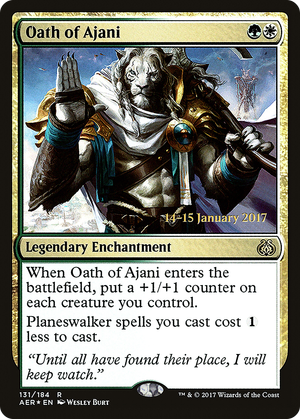
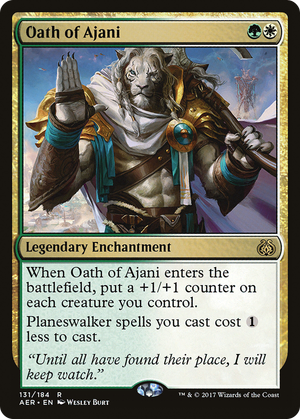
Oath of Ajani


The two halves point at completely different decks, and that split is the whole tension here. The enters trigger is an aggro payoff: a board-wide counter that rewards a flooded battlefield, the kind of effect that wants creatures already deployed when you cast it. The static ability is a control-and-superfriends incentive, shaving a generic mana off every planeswalker you cast, the kind of effect that wants a deck thin on creatures and heavy on the loyalty engine. A pure aggro deck has few planeswalkers to discount; a planeswalker deck rarely fields enough creatures for the counters to matter. The card asks for a middle build that fields a wide enough board to justify the trigger and runs enough planeswalkers to bank the discount, which in practice means a creature-leaning Green-White shell that treats walkers as its top end rather than its core. The cost reduction also compounds in a way the counter does not: every walker you resolve afterward is cheaper, so the static half is the one that scales with the game while the trigger is a one-time burst on arrival. It is named for a planeswalker and built to enable planeswalkers, but the body of the card is most at home alongside creatures, and reconciling that pull is the deckbuilding problem it sets.
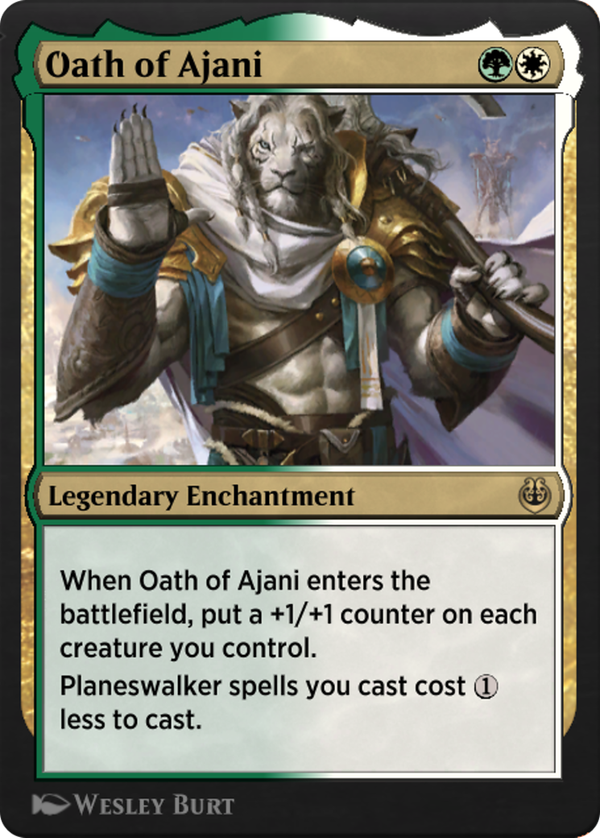
Rules text
 less to cast.