Nurturing Bristleback


The design bet here is that a card carrying serious late-game beef never truly clogs your hand, because it always has a job in the early game too. Seven mana for a 5/5 that drags a 3/3 token along with it is a fine payoff when it lands: eight power across two bodies, both trading up against most midrange creatures. But the mode that earns the slot is on the back end. At two mana it stops being a fatty and becomes a Forest: a land drop and a shuffle exactly when what you needed was a color source, not a finisher. That two-mode structure (top-end beater or early-game fixing) is the oldest problem landcycling was built to solve, going back to the cycling lands of the Onslaught era and everything that inherited the idea. What it buys the deckbuilder is the freedom to run a heavier curve without paying the usual flooding tax on expensive cards stuck in the opening turns, since the card's floor is never a dead draw: it either casts as two blockers off one card or cycles away for the land you were missing. Nothing about the rate is remarkable, and it doesn't need to be. This is a curve-smoothing tool wearing a beater's stat line, and the flexibility, not the numbers, is why it beats a plain 5/5.
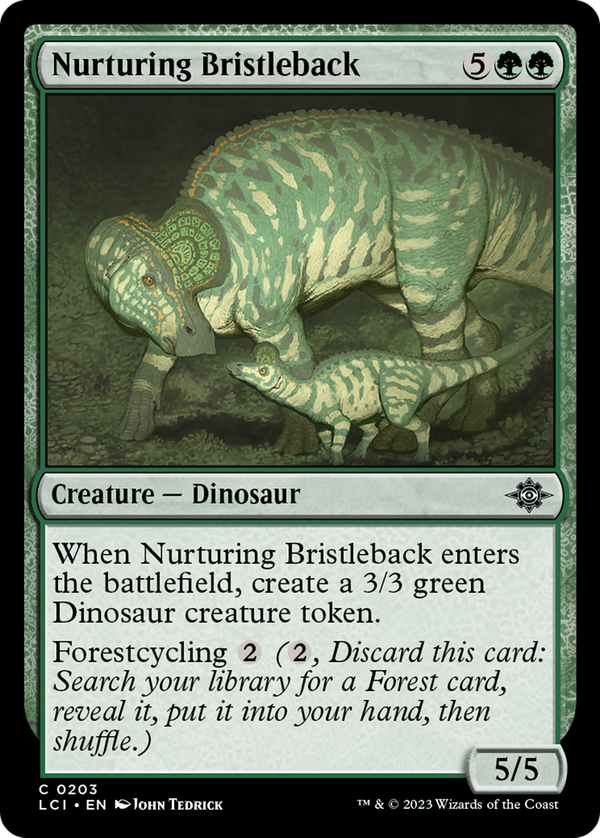
Rules text
 (, Discard this card: Search your library for a Forest card, reveal it, put it into your hand, then shuffle.)