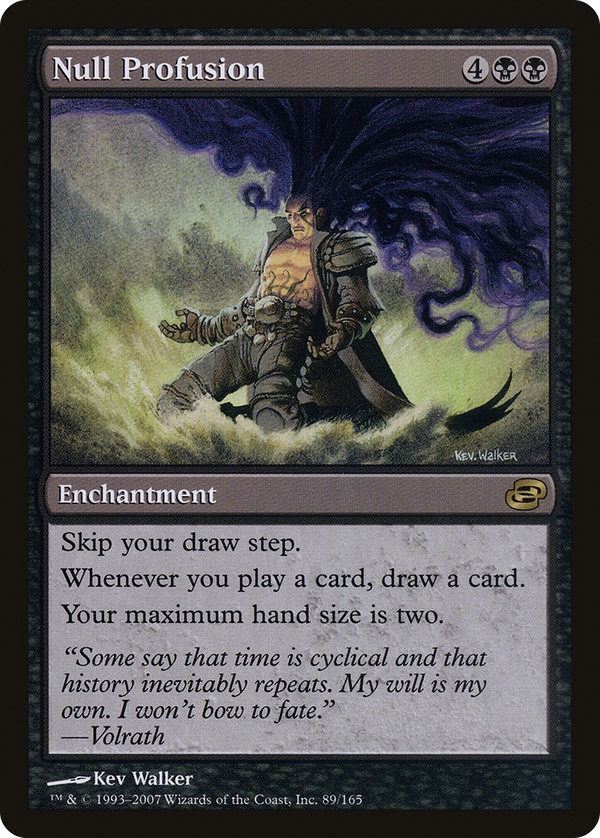
Null Profusion


The trade it offers is brutal in both directions: every card you play replaces itself, so a deck running this can chain spells as long as it keeps casting, but the two-card hand cap means you can never hoard. You spend or you stall. Skipping the draw step is the cost that keeps the engine honest; without it, the replacement trigger would simply double your card flow, so the design pulls back the natural draw and routes everything through play instead. The result punishes hesitation and rewards a low-curve, high-density list where you are always emptying your hand back to nothing and refilling on the way down. It reads as one of the era's Phyrexian-flavored enchantments that color black's card advantage as something extracted under strain rather than freely accrued, a counterweight to the open-handed blue draw of the same period. The maximum-hand-size clause does the structural work that an exile cost or a life payment does on other engines: it caps the upside so the symmetry of "draw on every play" cannot snowball into an unbounded turn unless the rest of the deck is built to abuse it. The seam to exploit is the word "play": cheap and free spells trip the trigger without draining a hand that is already shallow, while permanents that enter without being played (tokens, anything cheated onto the battlefield) sit outside the engine entirely. The card asks for that kind of intentional construction rather than handing the payoff over for free.