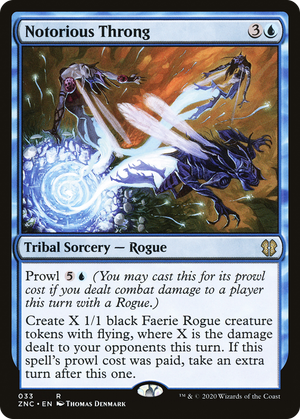
Notorious Throng


The reward structure here is a feedback loop disguised as a payoff. The prowl cost asks for something close to what the spell's output measures: prowl needs combat damage to a player with a Rogue, while the token count scales off all damage dealt to your opponents this turn. Connect with a Rogue and you unlock the prowl cost, which builds the token count off how much damage you dealt and then hands you another turn to do it again, with the freshly-minted Faerie Rogues now part of the attacking force. That recursion is the whole design tension. Note that the prowl price is not a discount: at  it costs more than the base , so what prowl buys is not efficiency but the extra-turn rider, gated behind the condition that you already won a combat step. It is a spell that pays out hardest in the exact game state where you least need help and does almost nothing in the game state where you do. That is not a flaw so much as the point of prowl as a mechanic: it priced its effects for the board an evasive aggressive deck has when it has done its job, not the board you wish you had. The extra turn is treated as a finisher rather than a combo enabler, since the tokens cannot meaningfully chain on their own; the turn just lets you swing again with a wider, more evasive board. A kindred sorcery built for one deck doing one thing well, committed to that narrow promise completely.
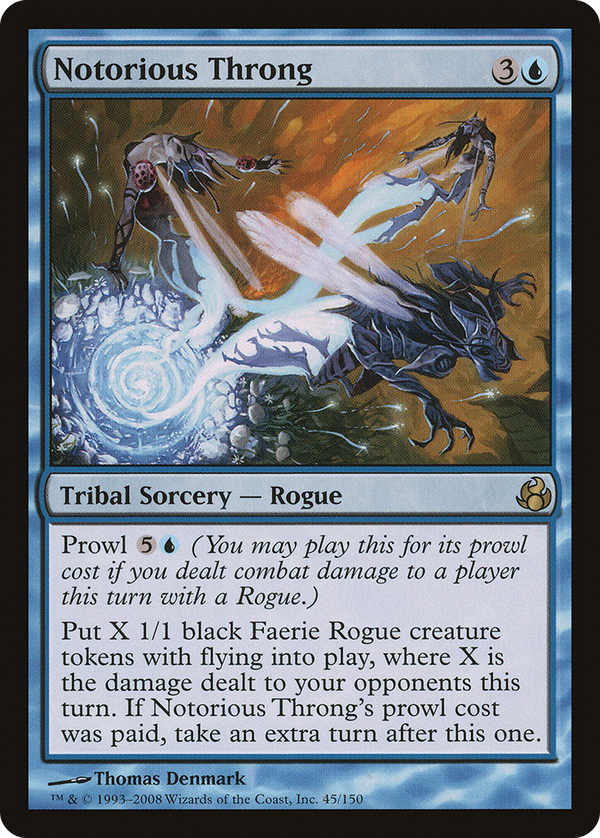
Rules text
(You may cast this for its prowl cost if you dealt combat damage to a player this turn with a Rogue.)
Create X 1/1 black Faerie Rogue creature tokens with flying, where X is the damage dealt to your opponents this turn. If this spell's prowl cost was paid, take an extra turn after this one.