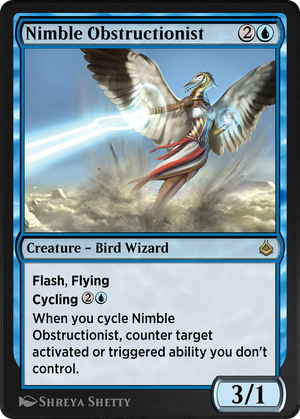
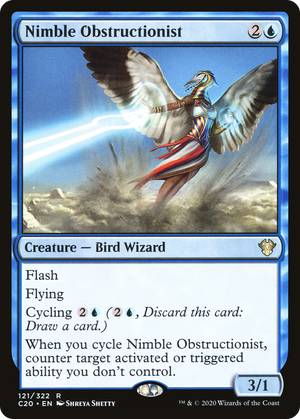
Nimble Obstructionist


Stifle on a stick, with the option to keep the stick. The defining trick of this design is that the counter effect lives in the cycling clause, not the cast clause: pay the cycling cost, discard the card, replace it, and counter target activated or triggered ability you don't control. That decoupling is the whole point. A dedicated counter for narrow interaction would rot in hand against decks that never present a target; here the floor is a fresh card, and the ceiling is a tempo-positive counter that pays for itself. The body is the insurance policy: when nothing on the board needs answering, a 3/1 flyer with flash ambushes an attacker, blocks at instant speed, or simply applies clock pressure. Few utility answers carry that little downside, because the dead-draw tax that plagues narrow interaction has been engineered out at both ends. The play pattern it rewards is patience. The card is never truly stranded: against a fetchland crack, a planeswalker activation, a storm trigger, or an enters-the-battlefield ability you want to deny, the cycling counter does precise work; against everything else, you hold a flash threat to deploy on their end step. It is one of the cleaner solutions to a recurring design tension: how to make a hard answer to a narrow problem worth a maindeck slot without it becoming a liability when the problem never shows up.
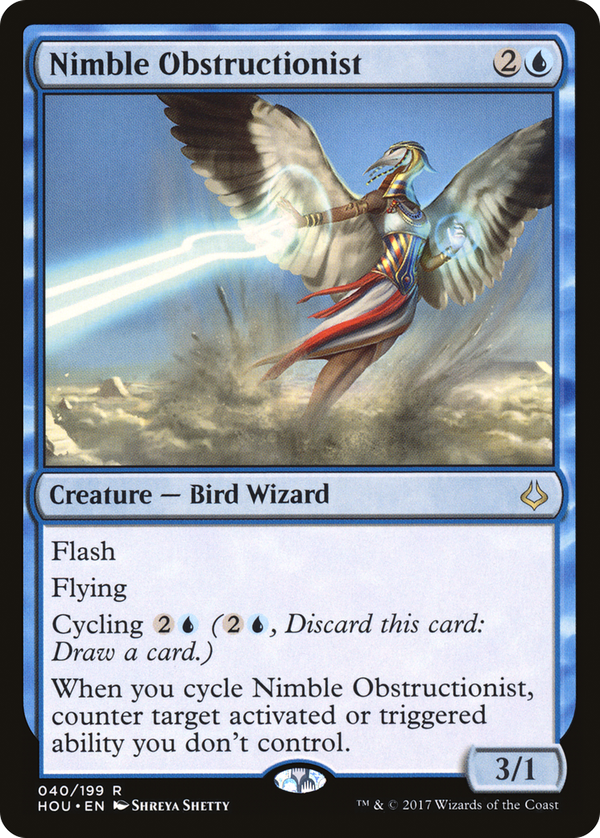
Rules text
(, Discard this card: Draw a card.)
When you cycle this card, counter target activated or triggered ability you don't control.