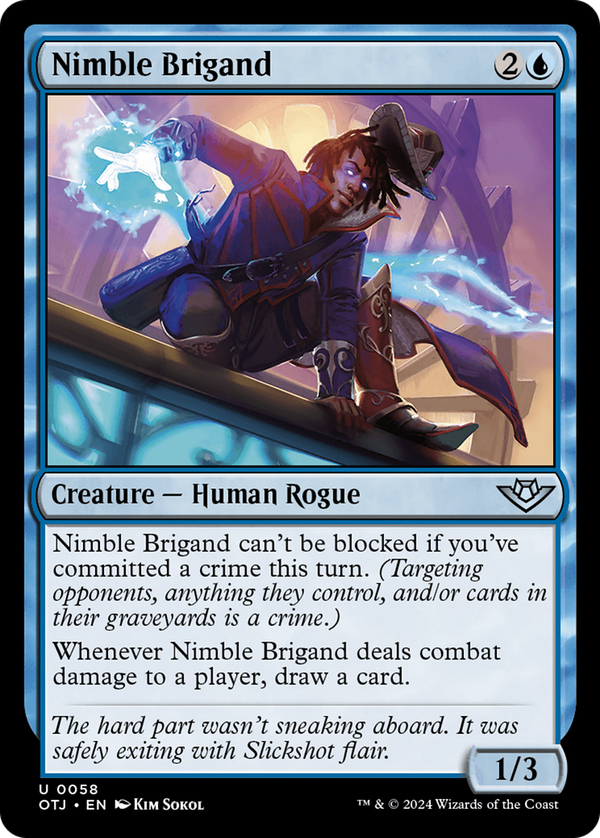
Nimble Brigand


The unblockable clause is gated behind an action, not a state, and that inversion is what the design turns on. Older evasive threats that drew cards on connection either paid a stiff premium or built the evasion into their own bodies. Here the evasion is conditional and priced cheaply, on the assumption that you will already be doing the thing that unlocks it: aiming interaction at an opponent or something they control, whether that means killing a creature, bouncing a permanent, or burning a face. The 1/3 body is telling. This is not a beater; it is a defensive frame that survives early combat and threatens nothing until the crime condition switches on, at which point one unblocked point of damage replaces the spell you spent committing the crime, keeping a spell-dense deck's hand from thinning out. That is the real payoff: not raw card advantage but attrition insurance, a body that pays back its own upkeep every time you were going to point removal at an opponent regardless. The toughness earns its keep on defense, walling one-drops and small attackers while you wait for a turn with a spell to cast anyway; the low power means it is not looking to trade in combat so much as to slip past it. The problem the designers had to solve was how to make a repeatable, low-cost draw engine inside an interactive deck without printing a body that would be unblockable in a vacuum and miserable to face. Their answer was to make the evasion a reward for playing the way that deck already plays.