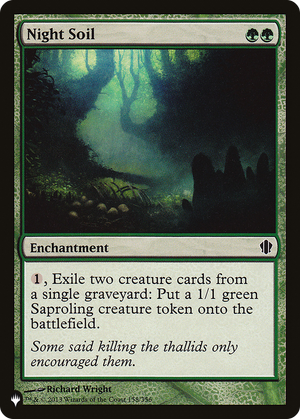
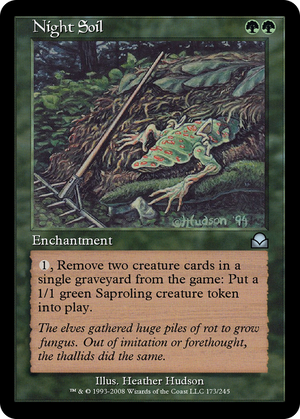
Night Soil

Graveyard hate that builds a board instead of just emptying one: the design idea here is that the cost of disrupting an opponent's recursion is also the price of your own incremental army. Most early graveyard interaction was a tax, a one-time exile or a Tormod's Crypt-style detonation that left you with nothing but the disruption. This turns the exile into fuel, converting two dead bodies (yours or theirs) into a fresh 1/1 each activation. The symmetry and the math are what keep the rate grindy: it eats from a single graveyard, two cards at a time, for a mana per token, so this is attrition tooling rather than a value engine that snowballs. The flavor reading is unusually literal for the era, the dead composting into new growth, and it sits inside a set built around grinding, expendable creatures, where a recurring source of chump blockers and sacrifice fodder had real texture. What makes it a green card rather than a black one is telling: green gets the regrowth-as-life angle, fertility out of decay, while black's graveyard cards of the period leaned on reanimation and drain. The token-generation chassis it runs on (repeatable, cheap, no upper bound but the available bodies) is the same skeleton later green and white engines would refine, but few of them kept the disruption clause stapled on as cleanly.
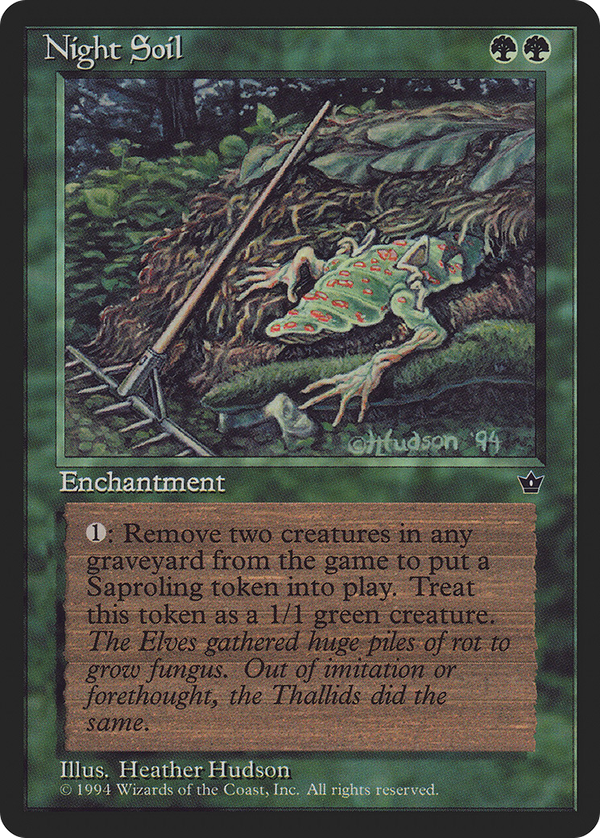

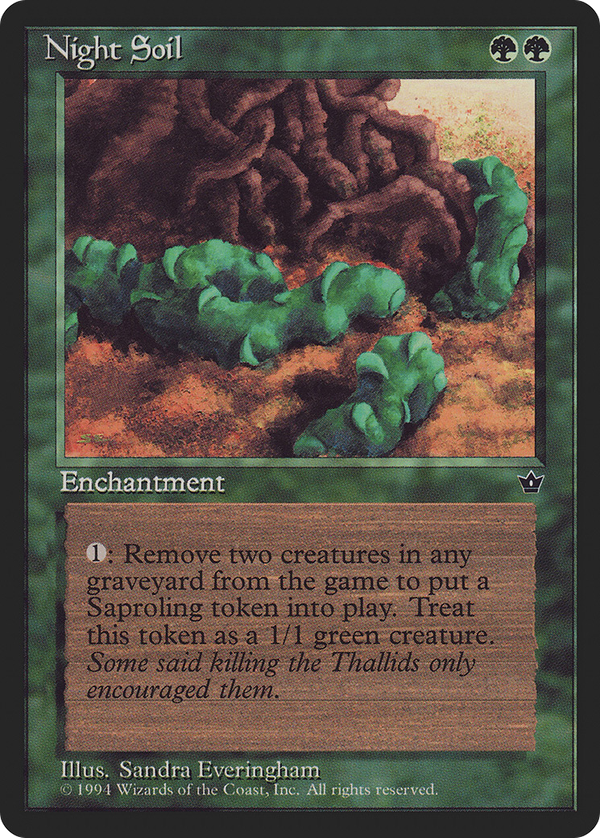
Rules text
 , Exile two creature cards from a single graveyard: Create a 1/1 green Saproling creature token.