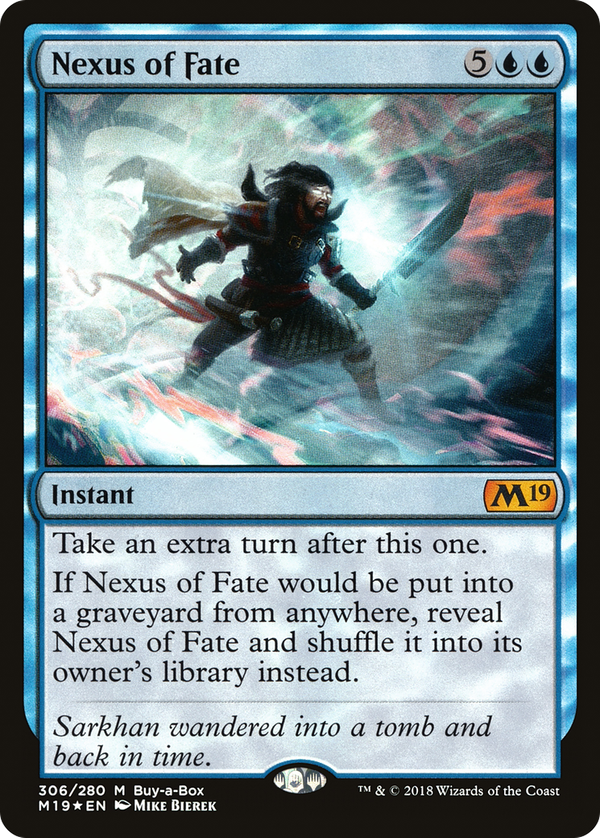
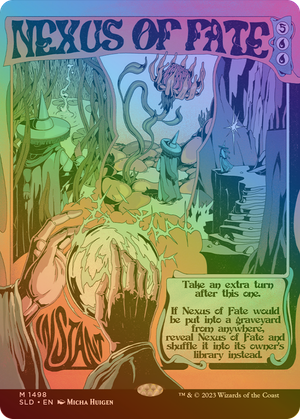
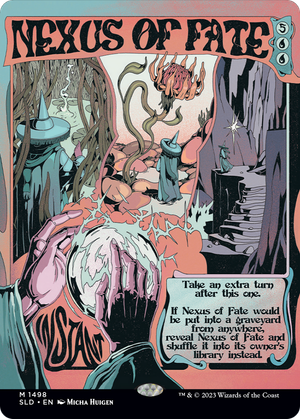
Nexus of Fate


Extra-turn spells have always carried the same liability: draw one, cast it, and you are down a card with nothing to show for it if the chain breaks. The second line of text erases that liability entirely. A card that shuffles itself back rather than going to the graveyard can never be milled out, never be discarded for good, and never spent for keeps; a deck that finds it once can find it again, which turns a one-shot tempo play into a renewable resource. That reusability is what made it a lightning rod. The same replacement effect that keeps it from ever hitting the graveyard also means the usual disruption fails: countering, discarding, or milling it just returns it to the library, so there is no way to grind the deck out of a card it keeps burying back into itself. What it does not do is loop through recursion, precisely because it never reaches a graveyard to recur from; the engine runs on drawing and finding, not returning from the yard, and the deck's own card selection is what closes the gap. Seven mana is the only real governor on the design, and in shells with ritual acceleration or repeatable tutoring, seven is a speed bump rather than a wall. It is the rare extra-turn effect built to be cast more than once, a single deviation from every earlier Time Walk variant that kept it surfacing in the bans conversation wherever it grew too consistent.