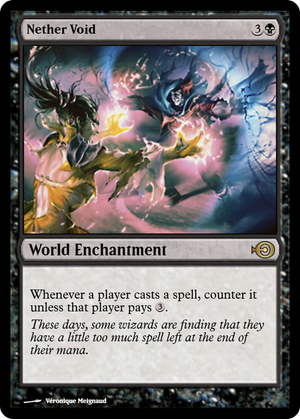
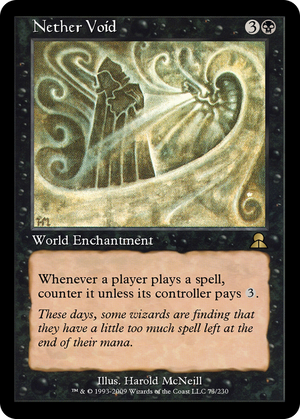
Nether Void


The purest expression of the tax-counter design: every spell costs three more, no exceptions, no escapes for the controller. Mana Drain came a year earlier as a sharp, single-target counter; Sphere of Resistance came later to slow everyone evenly. Nether Void sits between those poles and pushes harder than either, because the tax is not "more mana to cast" but "more mana or it does not resolve at all." That distinction is the whole card: a creature spell met with a Sphere still resolves once you pay, while a creature spell met with Nether Void simply ceases to exist unless the three appears. It is a soft counter, the cleanest one ever printed, with the soft tax set permanently high enough to feel like a hard one. The World enchantment frame is what kept this from being completely oppressive in its era: any opponent who landed a second one turned the original off, and the type has been all but retired since, which means there is no modern analogue that taxes this symmetrically and this hard. The asymmetry, then, is structural rather than written: the Nether Void player is the one who built a deck around resolving spells under it, with rituals, low curves, or mana acceleration that outpaces the three-tax. Everyone else is paying retail on every cantrip. It is a piece of black's old prison toolkit, from a period when Wizards was willing to print symmetric lockpieces and trust the format to sort out who actually wanted to play under them.
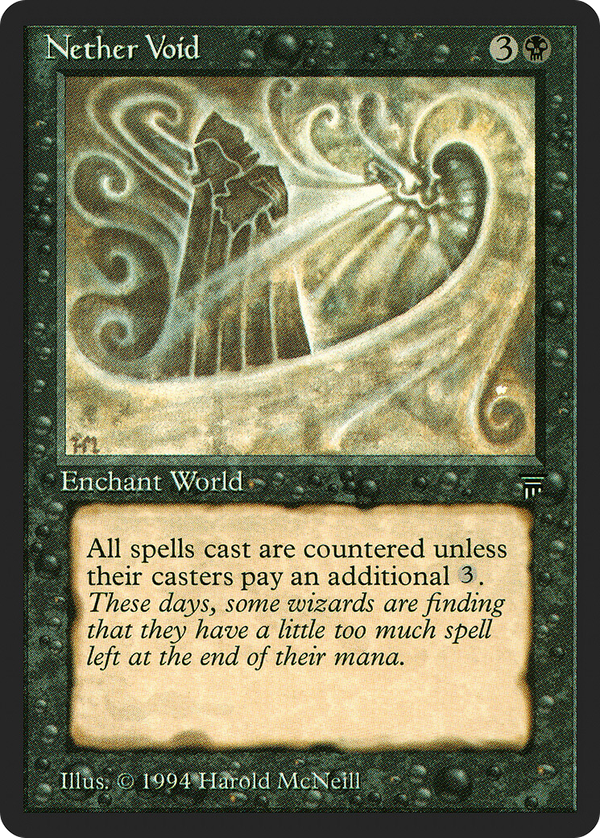
Rules text
.