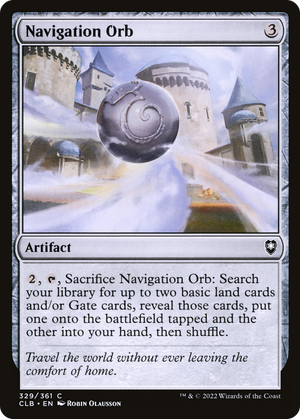
Navigation Orb

The reason this exists is Gates. A plain two-basic tutor would have no business fetching a nonbasic land, but folding Gate cards into the same search turns a generic fixer into a build-around: it thins toward whichever Gate payoffs a deck is running while still guaranteeing color access. The split delivery is the wrinkle worth noting: one land hits the battlefield tapped, the other goes to hand, so a single activation both develops the board and refuels a land drop for next turn. That two-for-one distinguishes it from the older single-target rock tutors it descends from, where sacrificing the artifact paid for exactly one land. Priced at three to cast and two more to crack, it is deliberately slow (a durable ramp piece rather than an early-tempo play), and it can sit on the battlefield until the deck is ready to spend the mana. The design tension it resolves is fixing versus card advantage: most sacrifice-for-lands artifacts pick one, replacing themselves with a single land while netting you no cards. This one keeps you flush by putting a card in hand alongside the land it drops, which is why it slots into slow, color-hungry shells that would otherwise stumble on their draws. Strip out the Gate line and it is still a competent two-basic fetcher; leave it in, and it becomes the connective tissue of a Gate deck's mana.
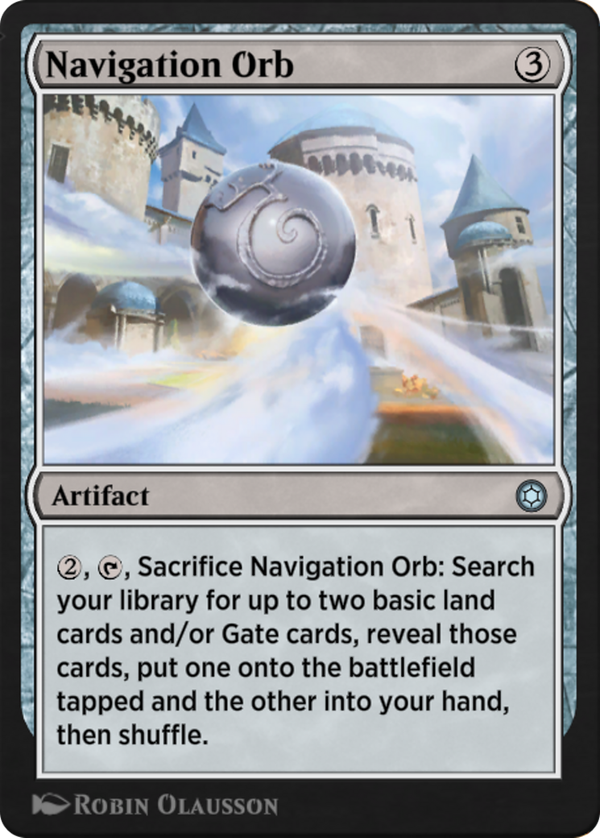
Rules text
 ,
,  , Sacrifice this artifact: Search your library for up to two basic land cards and/or Gate cards, reveal those cards, put one onto the battlefield tapped and the other into your hand, then shuffle.