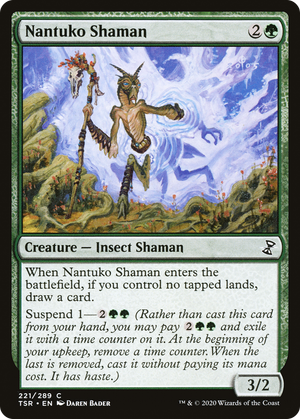
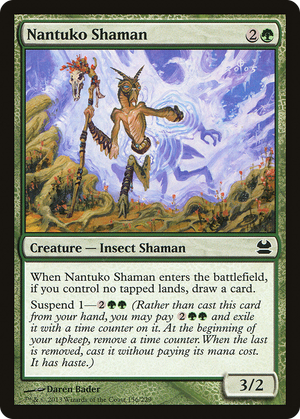
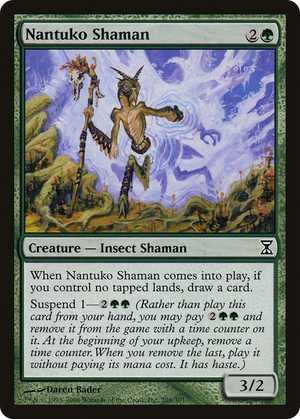
Nantuko Shaman


The conditional on the draw trigger is the whole puzzle: you refill only if you control no tapped lands when the creature enters, which means hardcasting it on curve actively fails its own bonus. Spend three mana to play it and the lands you tapped to do so are sitting tapped when the trigger checks, so you get the 3/2 and nothing more. The only clean way to bank the card is to not be the one tapping lands that turn, which is exactly what the suspend cost is built around. Pay ahead, let the time counter tick off on your upkeep before you've touched a land, and the creature enters into an untapped board: the draw is essentially guaranteed, and it arrives with haste on top. The mana you spent earlier does not count against the condition; what is tapped when the creature enters, and again when the trigger resolves, is all that matters. That inversion is the design's quiet joke. A three-drop cantrip wants to be played as a tempo body, but its reward is gated behind playing it the slow way, paying up front and waiting a turn rather than slotting it into a tapped-out turn. It rewards reading the condition literally instead of trusting the green-creature instinct to just jam it. The whole card turns on that single clause, a small dividend paid only to the player who sequences around it.
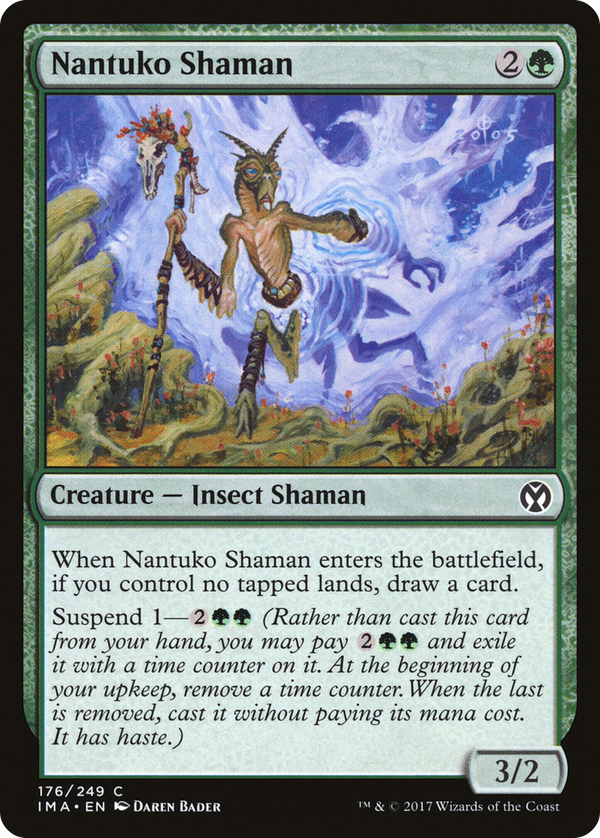
Rules text
(Rather than cast this card from your hand, you may pay and exile it with a time counter on it. At the beginning of your upkeep, remove a time counter. When the last is removed, you may cast it without paying its mana cost. It has haste.)