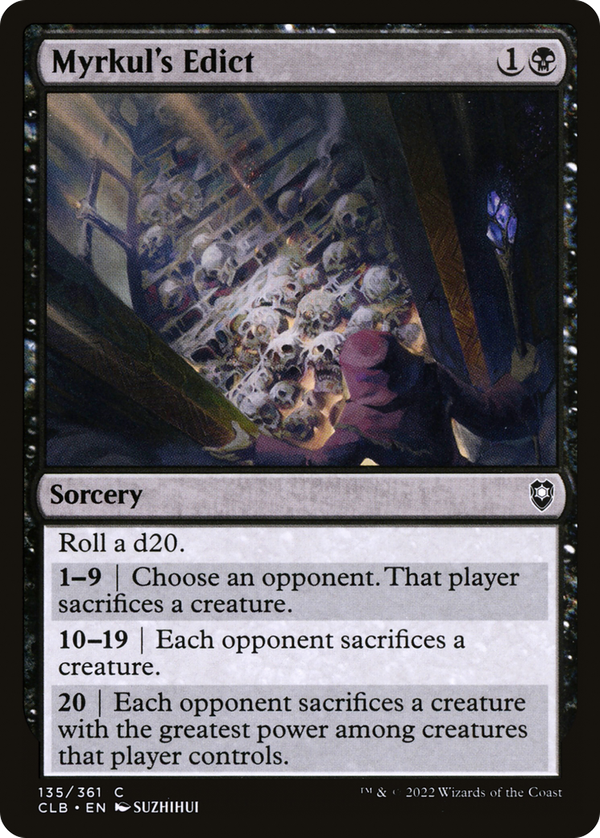
Myrkul's Edict


Edicts have always traded reliability for reach: you force a sacrifice, but the defender picks which creature dies, so the effect bottoms out against a spare token. This one hands that resolution to a d20 and sorts the payoff into three tiers. The low roll delivers a plain single-target edict against one player of your choosing, the weakest of the three outcomes. The middle band, the likeliest result, widens the effect to strip a creature from every opponent at once. And the natural 20 does the thing edicts structurally cannot: it forces each opponent to lose their highest-power creature rather than their most disposable body, closing the escape hatch the template has always left open. That top result is the whole reason to reach for the die: the standing weakness of an edict is that the opponent chooses, and the 20 revokes that choice. Everything worth caring about lives in the spread between the three bands: a floor that matches a vanilla edict, a common case that punishes every opponent at once, and a ceiling that answers what edicts historically cannot. The structure rewards a crowded board, where more opponents mean more forced sacrifices on the middle roll and more genuine threats stripped on the 20, turning a card that reads like a coin flip into a variance engine that overperforms exactly when the table is at its fullest.