Mwonvuli Ooze

Growth here is a debt that compounds, and the mechanic doing the compounding is among the most punishing the game has shipped. Cumulative upkeep stacks a fresh age counter onto the permanent each upkeep, then demands payment for every counter ever accrued, so the tax bends sharply upward while you stand still. What makes this Ooze a curiosity rather than a trap is how the scaling is rigged: the body grows at twice the rate of the counter pile, so by the time the upkeep has become genuinely heavy it is also a sizable threat. You end up choosing between an escalating beating and a graceful sacrifice. That is the design tension the era leaned on: the mechanic was meant to make a strong early body something you would eventually let die rather than keep feeding, and the work is extracting the most value before the bill outpaces the payoff. The card never asks for ramp or a build-around; it just runs an internal clock that you, not your opponent, are racing. Cumulative upkeep largely retired after this period of design, which leaves the Ooze as a fossil of a balancing philosophy the game has since abandoned: pay-as-you-grow, where the threat and the tax are bolted to the same counter.
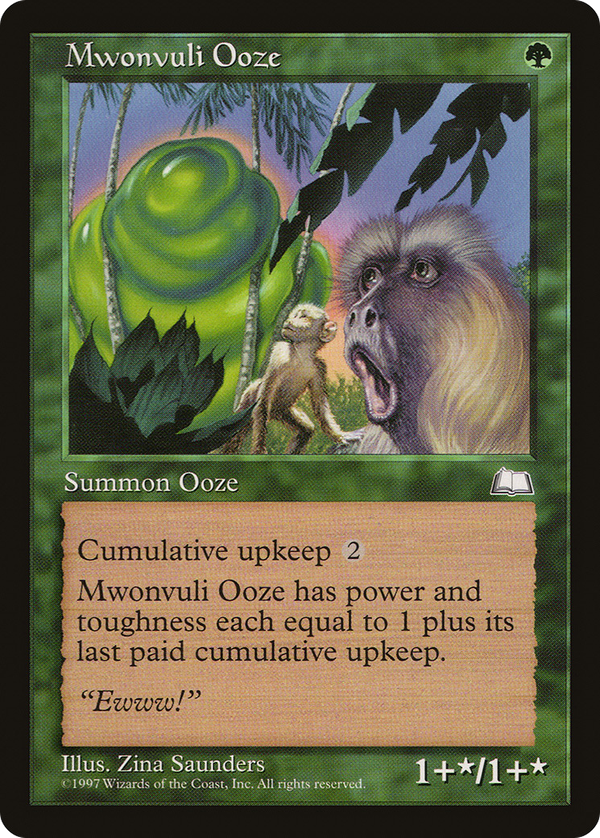
Rules text
 (At the beginning of your upkeep, put an age counter on this permanent, then sacrifice it unless you pay for each age counter on it.)
Mwonvuli Ooze's power and toughness are each equal to 1 plus twice the number of age counters on it.
(At the beginning of your upkeep, put an age counter on this permanent, then sacrifice it unless you pay for each age counter on it.)
Mwonvuli Ooze's power and toughness are each equal to 1 plus twice the number of age counters on it.