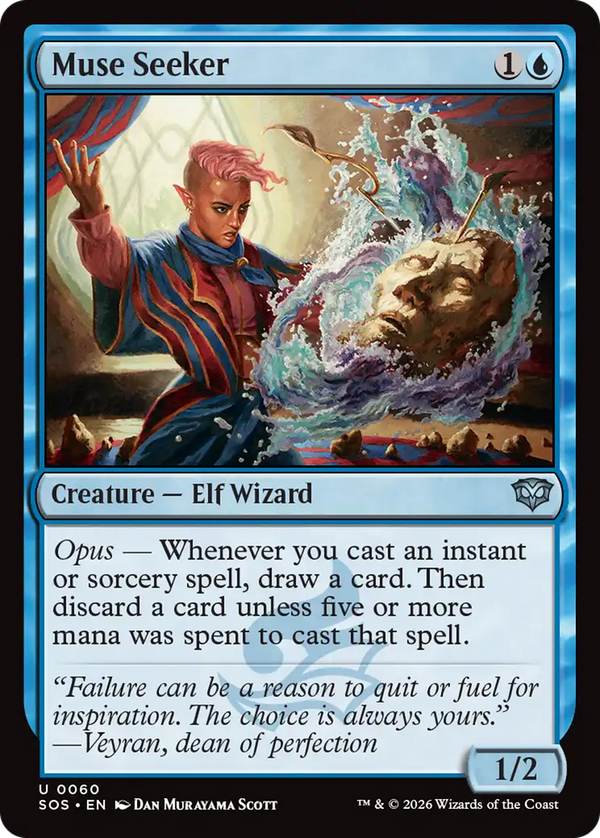
Muse Seeker


The Opus keyword folds a threshold clause directly into the trigger, and that clause is what reorients the entire engine. Strip it away and this would be a familiar spells-matter cantrip: sling a cheap spell, replace it, repeat. What the design does instead is tax the small spells and reward the big ones. Every one- and two-mana spell you chain draws a card but forces a discard, so the loot nets out to filtering, not raw advantage. The engine only turns positive when five or more mana is spent to cast a single spell, at which point the discard falls away and the draw comes free. That number quietly redefines who wants this card: not the pilot machine-gunning one-mana spells all game, but the deck built to sink five or more mana into a single spell anyway. The 1/2 body is beside the point; the card is a permission slip that staples a card to your late-game bombs. It descends from a lineage of creatures that turn instant-and-sorcery casting into card flow, but where most of those pay out on volume, this one polices it, drawing a hard line between spellslinging that merely churns and spellslinging that commits real mana to the stack.