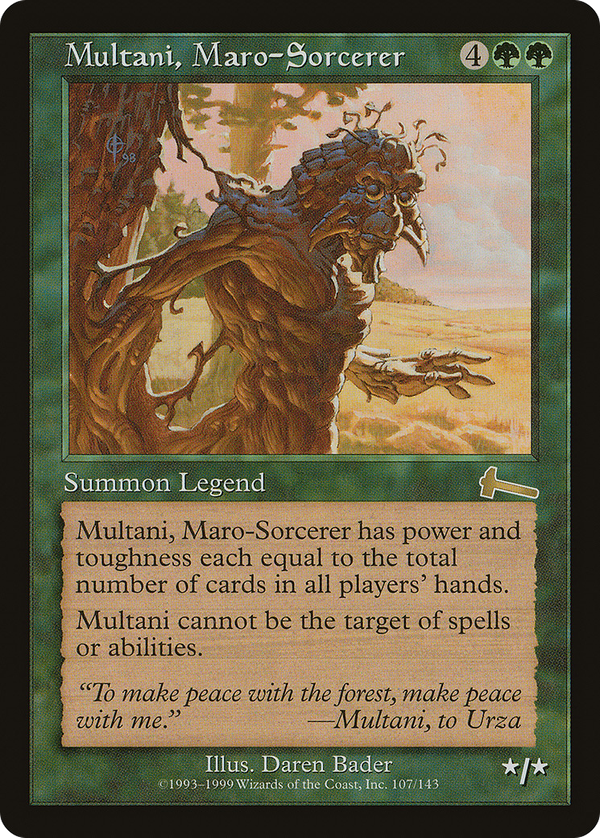
Multani, Maro-Sorcerer


The Maro template, named after Mark Rosewater himself, ties a creature's body to a public game-state number that both players touch. Here the number is the total cards in every hand, which makes this a barometer rather than a finisher: in a field of empty grips it is dead weight, but across full hands it swells into something that ends games quickly. The design tension is that you do not own the variable outright. An opponent emptying their hand shrinks it; your own draw-heavy build inflates it. That shared dependency keeps a potentially enormous body honest, and it is why the card demands you manufacture the conditions (card draw, forced hand-filling) rather than simply cast and swing.
Shroud is the structural decision that completes the package. A creature whose size scales with the board needs protection from the spot removal that would otherwise punish the investment, and shroud grants exactly that by walling it off from targeting entirely. The cost is symmetry: you cannot pump it, equip it, or protect it with your own targeted spells, so the body has to fight on the raw arithmetic of hands alone. That self-imposed isolation is the discipline that makes the rate work. This is a creature built to be left alone, growing or shrinking on a clock nobody fully controls, immune to targeting and incapable of receiving help.