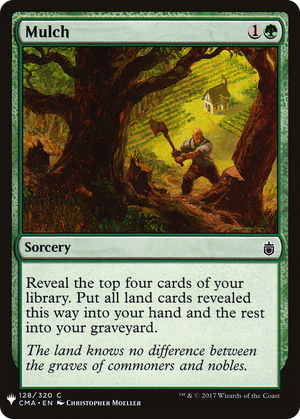
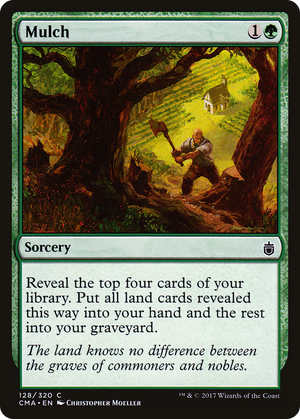
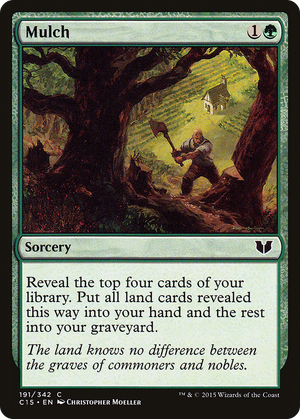
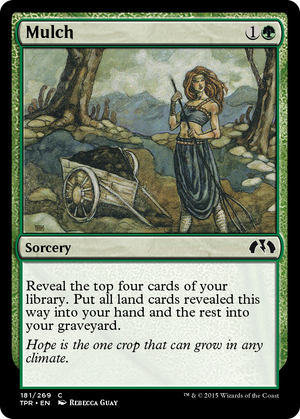
Mulch


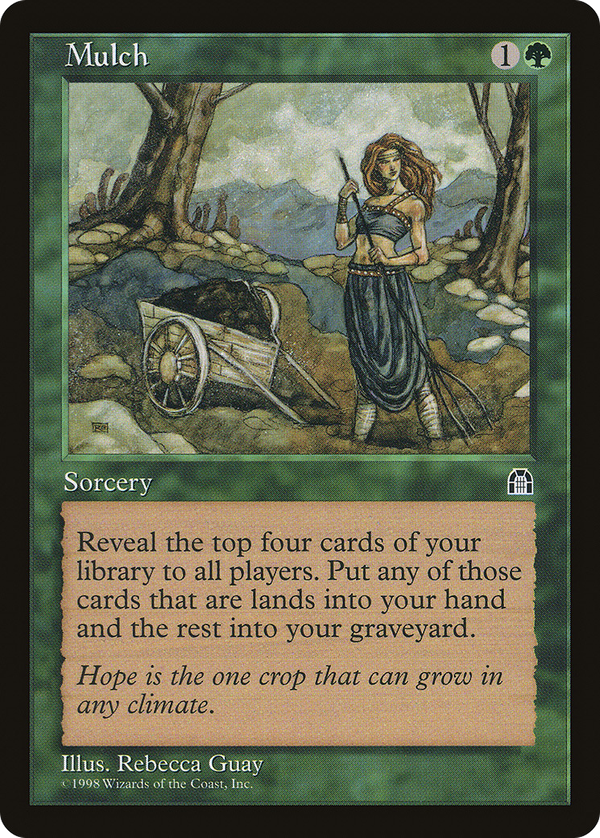
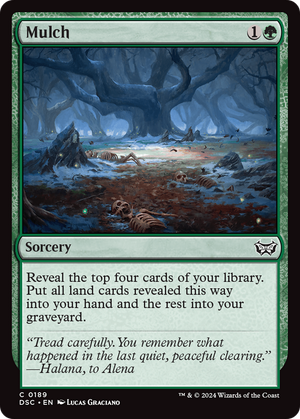
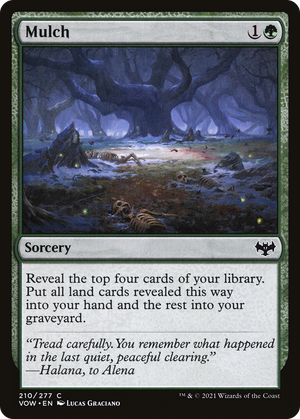
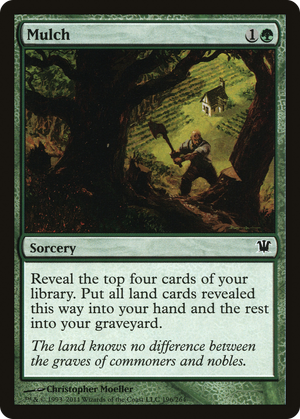
Two engines stapled together at cross purposes, and they actively work against each other. As a land-finder it is feast-or-famine: a reveal heavy on lands hands you several cards at once, a genuine spike of card advantage, while a land-light reveal leaves you with one or zero in hand and three or four spells dumped into the yard. The land-to-hand clause smooths your draws when the reveal cooperates and does nothing when it does not, so as a pure consistency spell it is unreliable by construction. As a graveyard-stocker it is the opposite: anything that is not a land goes straight to the bin, and that half of the card is the one that aged into relevance. Green graveyard strategies that want creatures, instants, and sorceries in the yard to feed reanimation, threshold, delve, or recursion get exactly that, with the land-to-hand clause functioning less as a benefit and more as a built-in throttle on how much you can dump per cast. The same clause that makes the lands stick is the one that caps your fill rate, so you cannot tune the card toward either job without the other half clawing back value. Most later self-mill is cleaner and more controllable, but this was an early attempt to let green convert raw library depth into two distinct resources at once, and the friction between those uses reads as the design's intent rather than its flaw.