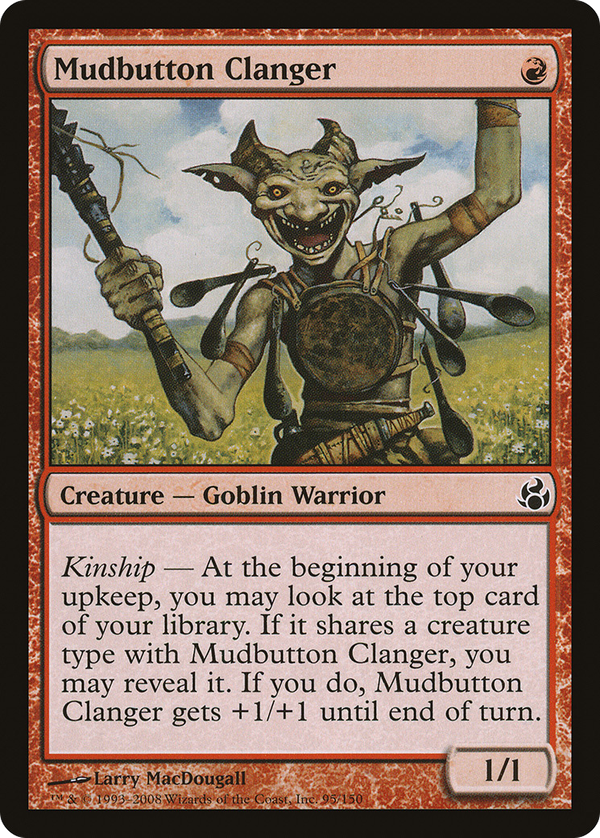
Mudbutton Clanger

Kinship was a strange answer to a real problem: how do you reward tribal commitment without making the payoff a binary on/off switch? The mechanic's solution was a soft upkeep peek, checking the card you're about to draw and asking whether it shares a creature type with the very creature carrying the ability. For this Goblin Warrior, that means a hit on either Goblin or Warrior, two of the deepest type pools in red, which makes its kinship check among the more reliable in the cycle and its reward among the most forgettable: a temporary +1/+1, gone by your next turn, on a body that was already going to attack. That gap between consistency and stakes is the whole tension of the mechanic in miniature. The kinship cards that wanted to matter (the ones whose reveal swung games) needed a wide spread of shareable types and a payoff worth chasing; this one optimizes for the hit rate and forgets to make the hit count. It is honest design for a tribal common, a token of intent more than a card you build toward, and it survives now as a footnote on a keyword that never came back. Kinship as a whole was a deliberate experiment in graveyard-free, library-ordering tribal payoffs, and where this one landed tells you why the line was not continued.