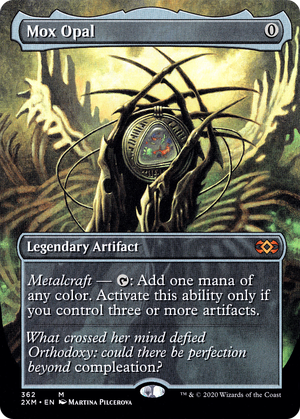
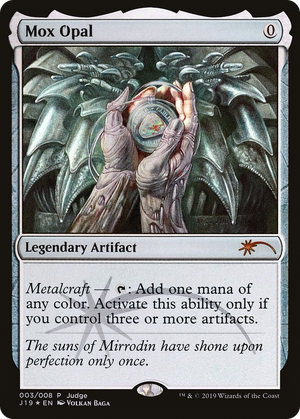
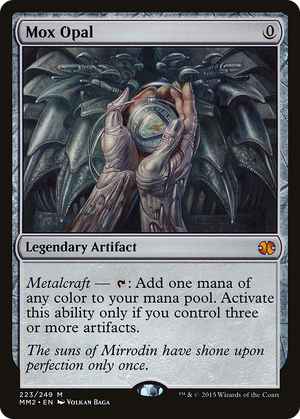
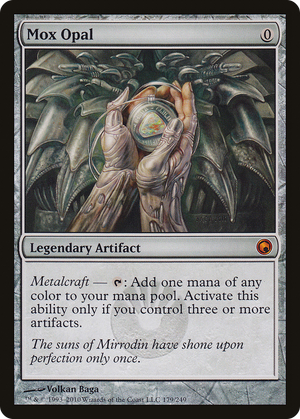
Mox Opal

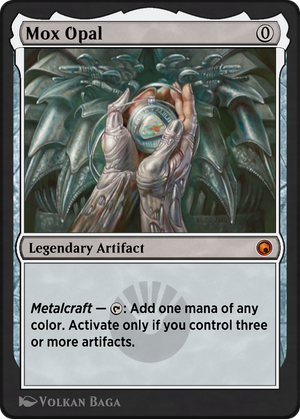
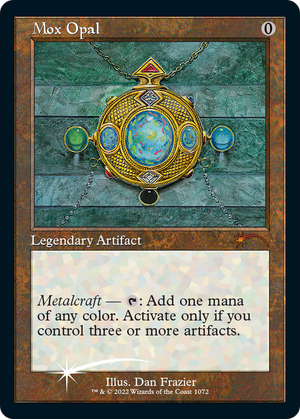
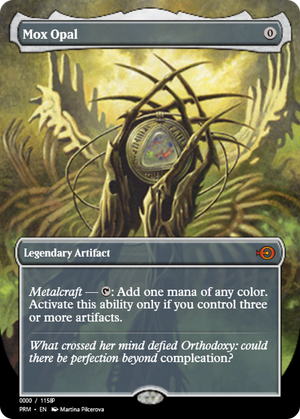
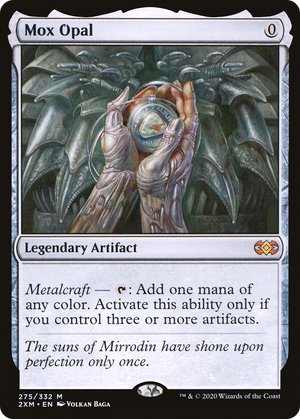
The Power Nine settled the question of whether a free mana rock could simply tap for color with no cost attached, and the answer for thirty years was that it could not be reprinted without breaking everything around it. This is the workaround Wizards found: keep the zero cost, keep the any-color output, but lock the tap behind a board state you have to earn. The metalcraft requirement turns a turn-one free Mox into a turn-three free Mox in any deck that is not already an artifact deck, and a genuine turn-one accelerant in one that is. That conditional is the entire balancing act. It self-restricts to exactly the shells that least need help curving out, which is also what makes it so dangerous in those shells: an artifact deck flooding the board produces three artifacts as a side effect of doing its normal thing, and once the condition is online the Opal is strictly free mana that also counts itself toward future thresholds. The legendary supertype is the other governor, capping the density at one even when the deck would happily run a playset. It is the clearest statement Wizards has made about how to print a Mox in the modern era: not by weakening the payoff, but by gating it behind a deckbuilding commitment that funnels the card into the precise archetype where free fixing is most explosive, then trusting bans to clean up when that proves too much.
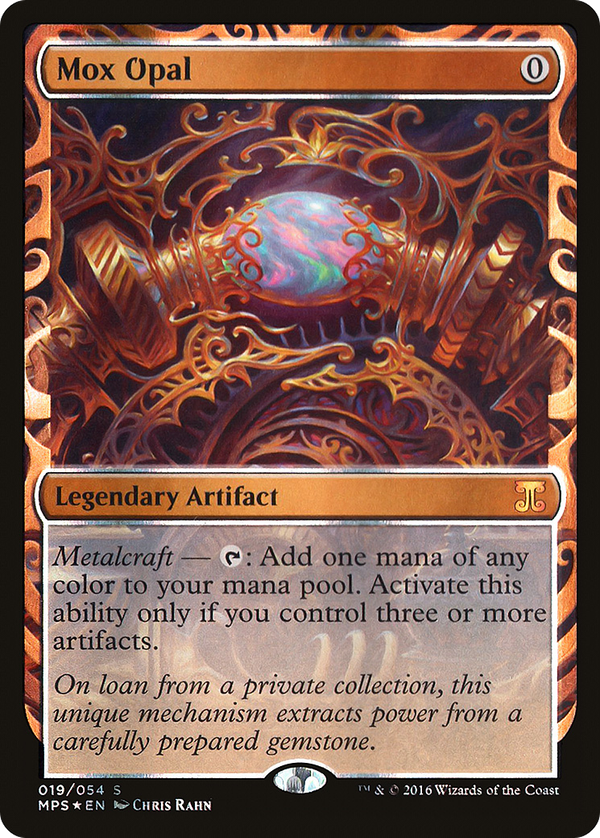
Rules text
 : Add one mana of any color. Activate only if you control three or more artifacts.